

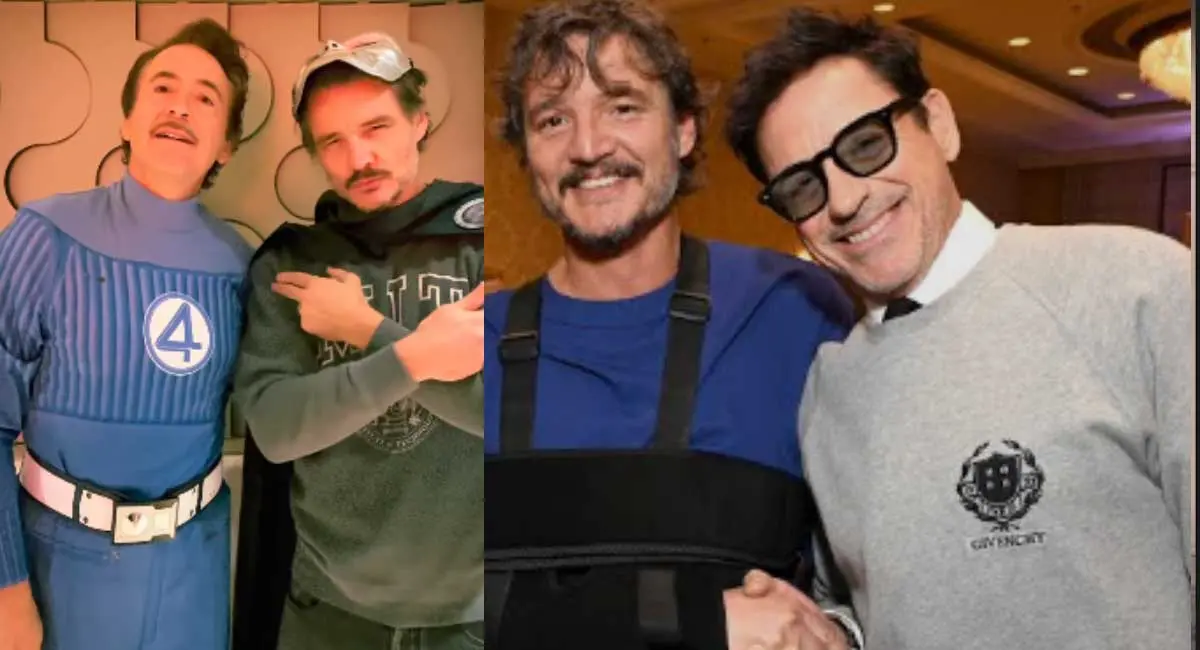
Robert Downey Jr. and Pedro Pascal turned Halloween 2026 into an unexpected Marvel crossover, swapping characters in a playful costume reveal that rapidly circulated among fans. The pair, whose current Marvel roles place them on opposite sides of the Fantastic Four mythos, used the holiday to invert expectations: Downey appeared as Reed Richards, the elastic leader of Marvel’s First Family, while Pascal took on the armored menace of Doctor Doom.
The swap was not tied to any announced scene, episode, or film. Instead, it functioned as an elaborate inside joke about the strange geometry of Marvel casting in the multiverse era. Downey, long synonymous with Tony Stark and Iron Man, is set to play Victor von Doom in the next Avengers chapter. Pascal, meanwhile, has already entered the Marvel fold as Reed Richards in the Fantastic Four’s latest big-screen outing. By trading costumes, the two actors briefly traded the assumptions audiences bring to their roles.
Key facts at a glance
- Robert Downey Jr. and Pedro Pascal marked Halloween 2026 with a Marvel character swap.
- Downey dressed as Reed Richards, also known as Mister Fantastic.
- Pascal dressed as Doctor Doom, the Fantastic Four’s most famous antagonist.
- The swap referenced their current and upcoming Marvel roles rather than an announced plot development.
- Fan reaction focused on the irony of the actor behind Iron Man playing Reed Richards while the actor behind Reed Richards played Doom.
- Neither actor indicated that the costume exchange would affect Marvel canon.
The timing gave the stunt extra resonance. Halloween 2026 arrived as Marvel Studios continued to build toward Avengers: Doomsday, the project that will place Downey’s Doctor Doom at the center of the franchise’s next large-scale conflict. Pascal’s Reed Richards, introduced in The Fantastic Four: First Steps, is expected to remain a key figure in the same narrative universe. The two characters share one of the oldest rivalries in Marvel comics, making any visual swap between their actors inherently loaded with meaning.
The role reversal and its comic-book roots
Doctor Doom and Reed Richards have been intertwined since their earliest appearances. Both were created by Stan Lee and Jack Kirby, and both emerged from the creative explosion that established the Fantastic Four as Marvel’s foundational superhero team. Reed is the brilliant scientist whose stretching powers and relentless curiosity define him. Doom is the monarch of Latveria, a scientist and sorcerer whose wounded pride and conviction that he alone can save the world turn him into a perpetual threat.
Their rivalry is not merely a matter of punching and property damage. It is a clash of intellects, egos, and philosophies. Reed believes in discovery, family, and imperfect but shared progress. Doom believes in order, control, and his own singular genius. That contrast has made them ideal foils for more than six decades. When Downey and Pascal swapped costumes, they were not just wearing each other’s outfits. They were briefly occupying opposite ends of a very old argument.
The swap also played with audience memory. Downey spent more than a decade as Tony Stark, a character whose charisma, wit, and technological brilliance helped define the early Marvel Cinematic Universe. His return as Doctor Doom is one of the most closely watched casting decisions in recent superhero cinema. Pascal, by contrast, arrived in Marvel after building a reputation across genre television, from Game of Thrones to The Mandalorian to The Last of Us. Seeing him in Doom’s armor invited fans to imagine a darker, more theatrical register for an actor often associated with warmth and weary decency.
Why the costumes landed as a fan event
Celebrity Halloween costumes have become a separate layer of pop culture, especially when they reference the projects that made the stars famous. A generic superhero costume can feel like a photo-op. A coordinated swap between two actors who are actively playing those characters feels like a message, even when no message is intended. The Downey-Pascal exchange worked because it required viewers to hold two layers of casting in mind at once.
Fans immediately began reading the images as a playful comment on the multiverse. If Downey can be Doom and Pascal can be Reed, then the boundaries between hero and villain, legacy and reinvention, are already porous. The swap did not need a trailer or a press release. It used the grammar of Halloween, where identity is temporarily reversible, to make a point about how Marvel now treats its own history. The joke was accessible to casual viewers who recognized the costumes and rewarding for comic-book readers who understood the deeper rivalry.
Social media discussion split into familiar camps. Some fans treated the swap as harmless fun and praised the actors for not taking themselves too seriously. Others searched for hidden clues about Avengers: Doomsday, wondering whether the images hinted at a variant, a dream sequence, or a marketing stunt. A third group used the moment to debate the ethics of casting Downey as Doom after his years as Iron Man. None of those reactions required an official answer. The ambiguity was part of the appeal.
Downey’s path from Iron Man to Doctor Doom
Robert Downey Jr.’s relationship with Marvel is one of the defining actor-franchise partnerships of the modern era. His casting as Tony Stark in 2008’s Iron Man was initially viewed with skepticism, given his troubled public history and the relative obscurity of the character outside comic circles. The film’s success reshaped the industry, and Downey’s performance became the emotional anchor of the Avengers era. His exit in Avengers: Endgame gave the franchise one of its most emphatic emotional beats.
That history makes his return as Doctor Doom unusually charged. Doom is not a replacement for Iron Man in a simple sense. He is a different kind of performer’s challenge: more theatrical, more imperious, and less dependent on charm. Downey has the range to play a grand villain, but the audience’s affection for Tony Stark will inevitably color the performance. The Halloween costume swap leaned into that tension by letting him wear the Fantastic Four uniform instead of Doom’s armor. For one night, the actor most associated with Marvel’s heroic past stood in the visual language of its family-oriented future.
Pascal’s expanding genre footprint
Pedro Pascal’s career has followed a different trajectory. He spent years in supporting roles before breaking through as Oberyn Martell in Game of Thrones, then became a leading man through Narcos, The Mandalorian, and The Last of Us. His appeal rests on a blend of charisma, vulnerability, and deadpan humor. Those qualities made him a natural fit for Reed Richards, a character who can be both a visionary scientist and an emotionally distant husband and father.
Playing Doctor Doom, even in a Halloween costume, flips that image. Doom is not vulnerable in the same way. He is wounded, yes, but he converts that wound into armor, both literal and psychological. Pascal’s costume choice suggested a willingness to play with his public persona. It also reminded fans that the actor’s range extends beyond the protective, paternal figures that have defined his recent work. The swap was brief, but it added a new image to the ongoing conversation about how Pascal might fit into Marvel’s larger ensemble.
The Fantastic Four rivalry in the MCU era
The Fantastic Four have long been central to Marvel’s comic-book universe, even when their film adaptations struggled. The team represents exploration, family, and scientific ambition. Doctor Doom represents the shadow side of those values: genius without humility, control without consent, and a belief that the world’s imperfections justify absolute rule. Bringing both into the MCU’s next phase gives Marvel a chance to stage a conflict that is intellectual and personal rather than merely cosmic.
Pedro Pascal’s Reed and Downey’s Doom are therefore positioned as more than a hero and a villain. They are two versions of the same promise: that exceptional intelligence can change reality. One believes that change should be shared. The other believes it should be commanded. The Halloween swap made that thematic opposition visible in a way that a press conference could not. It turned a pair of costumes into a small essay about the characters’ relationship.
Marketing, mystery, and the limits of the joke
Marvel has increasingly relied on casting announcements and fan speculation as part of its promotional cycle. In that environment, even a Halloween photo can become evidence in a larger investigation. The Downey-Pascal swap arrived with no official caption beyond the obvious role reversal, which meant fans could project their hopes and theories onto it. Some wanted confirmation that the actors share scenes. Others wanted reassurance that the tone of Avengers: Doomsday will not be overly solemn.
It is important to separate the costume from the canon. Nothing about the swap confirmed a plot twist, a variant, or a post-credits scene. Actors dress up for Halloween for the same reasons anyone else does: because it is fun, because friends coordinate, and because the internet rewards a good visual joke. The fact that these particular actors happen to be playing Marvel characters made the joke more visible, but it did not make it a studio announcement.
The restraint is part of the strategy. Marvel can let fans generate attention without committing to a narrative detail. The swap gave outlets and social accounts a fresh image to discuss, while the actual film remains the official text. If the costumes were designed to generate conversation, they succeeded. If they were simply a private Halloween moment that became public, they succeeded for a different reason: they showed the actors as collaborators rather than corporate messengers.
What the swap says about Marvel’s next phase
Marvel’s next phase is built on recombination. Characters from different franchises are being brought together, older actors are returning in new roles, and familiar stories are being filtered through the logic of the multiverse. The Downey-Pascal swap fits that moment because it is itself a recombination. It takes two actors, two characters, and two eras of Marvel storytelling and mixes them for a single holiday image.
The swap also highlights how much of modern franchise acting depends on audience familiarity. Downey and Pascal are not anonymous performers inside costumes. Their faces, voices, and previous roles travel with them. That is why the joke works. The audience knows who is supposed to be under the mask. The pleasure comes from the mismatch.
For fans, the moment will likely remain a curiosity rather than a clue. It sits alongside other off-screen Marvel interactions that generate enthusiasm without altering the films themselves. The costumes do not change the release calendar, the script, or the contracts. They do, however, show that the people at the center of the franchise understand its playful side. In a genre often criticized for taking itself too seriously, that matters.
As Halloween 2026 recedes, the images will keep circulating whenever Avengers: Doomsday or the Fantastic Four are discussed. They will be used as shorthand for the strange, self-aware casting that defines Marvel’s current era. The swap will not be remembered as a plot point. It will be remembered as a well-timed visual joke that captured the paradox of actors playing mythic characters while remaining visibly themselves.
For now, the only confirmed takeaway is that two actors at the center of Marvel’s next phase are comfortable turning their characters into Halloween material, and that fans are watching every stitch.
Source:ARY News News