

Key facts
- Keir Rodney Starmer was born on 2 September 1962 and grew up in a modest London household with one brother and two sisters.
- He is the leader of the Labour Party, a former director of public prosecutions and a human rights lawyer.
- He became Labour leader in April 2020, succeeding Jeremy Corbyn after a historic election defeat.
- He served as Labour's Brexit spokesperson and opposed Brexit.
- He is the favourite in the polls to become prime minister after the 4 July 2024 general election.
- His campaign emphasises 'seriousness', fiscal caution, centrist stability and a pro-business programme.
Keir Starmer has built his bid for 10 Downing Street on a deliberately understated promise: that Britain can be run with competence, restraint and a return to what he calls seriousness. The 61-year-old Labour leader, a former human rights lawyer and director of public prosecutions, is widely seen as the favourite to become prime minister after the 4 July general election. If the polls are right, he would take office after 14 years of Conservative-led government, at a time when public finances are strained and trust in politics has been damaged by repeated scandals.
Yet his path to that point has been anything but obvious. When he took over Labour in April 2020, the party was reeling from a historic electoral defeat and from deep internal divisions. Few commentators at the time predicted that the former lawyer, described by critics as austere and lacking charisma, would turn the party around without triggering the split that many had feared. Four years later, he has moved Labour back toward the centre, tightened its discipline and presented himself as a safe alternative to a government in disarray.
A methodical moderniser
Starmer's leadership has been defined less by flashy announcements than by methodical party management. He has repeatedly insisted that his priority is country first, party second, a phrase intended to distance Labour from the factional warfare of the Corbyn years and from the scandal-prone record of the Conservatives. During the campaign, he has avoided dramatic spending promises and has instead stressed fiscal discipline, national security and the need to restore confidence in public institutions. The Labour manifesto was openly pro-business, a shift designed to reassure voters and investors that the party would not return to the tax-and-spend image that Conservatives have long used against it.
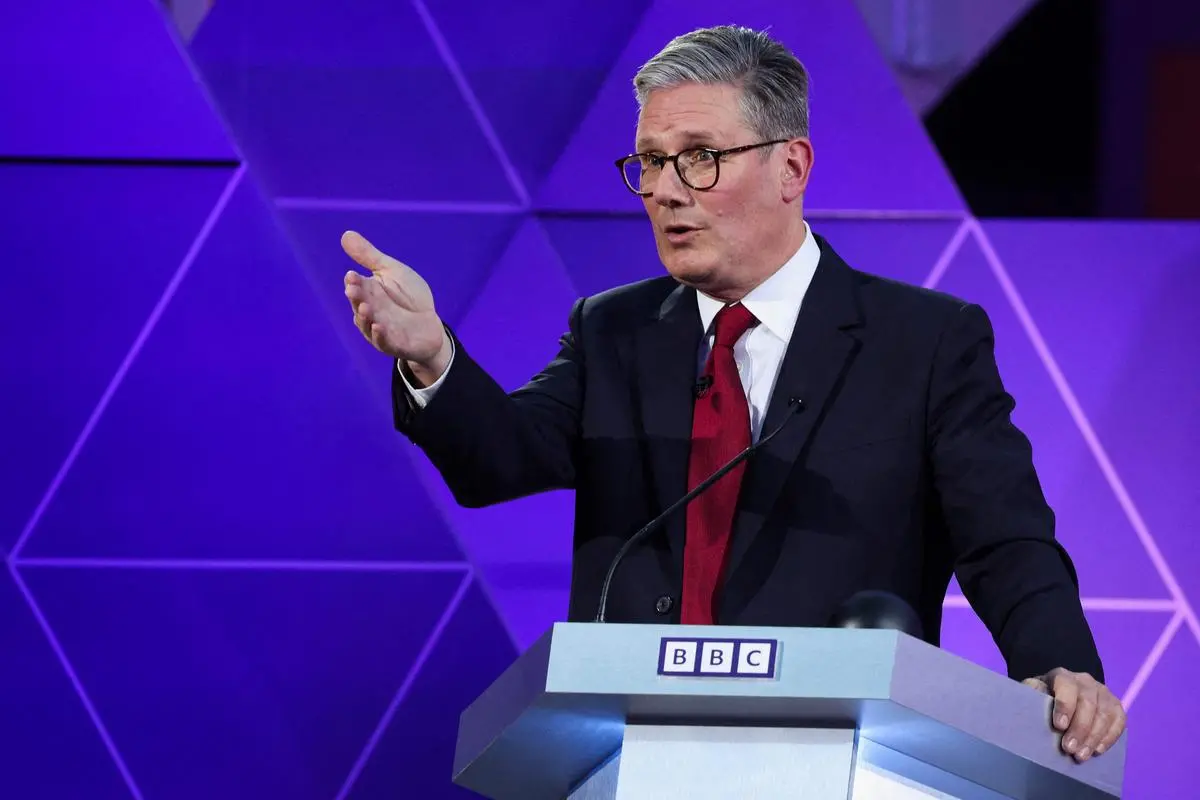
That caution has drawn criticism. Some voters and activists on the left argue that Labour's programme lacks ambition and offers only modest change. In one televised debate, a member of the public told Starmer that he looked like a political robot, a moment that briefly unsettled him. His response has been to lean harder on his personal story and on the argument that serious times demand serious government rather than spectacle. I am not running to be a circus director, he has said, I am running to be prime minister. The line captures both his self-image and his strategy: competence over charisma, management over drama.
From modest beginnings to the law
Keir Rodney Starmer was born on 2 September 1962. He grew up in a small house in London with a brother and two sisters. His father was a factory worker, and his mother was a nurse who suffered from a rare inflammatory joint disease that left her unable to walk for years. Starmer has often returned to this background on the campaign trail, telling audiences that he knows what it is like to feel embarrassed about bringing friends home because the carpet was worn and the windows were cracked. His unusual first name is a tribute to Keir Hardie, the founder of the Labour Party.
He studied law at Leeds and then at Oxford, and went on to build a career as a barrister specialising in human rights. He defended trade unions, fought cases against a major fast-food chain, and campaigned against the death penalty in the Caribbean. Friends and former colleagues describe him as meticulous, hard-working and deeply focused on the details of a case. Gavin Millar, a lawyer who worked with him and remained a friend, has said that those qualities would follow him into government, alongside a commitment to equality, human rights, social justice and reducing the gap between rich and poor.
His career also included a less glamorous but important period in Northern Ireland, where he helped rebuild policing after the Troubles. In 2008, he became director of public prosecutions for England and Wales. In that role, he oversaw prosecutions involving members of parliament who abused their expenses, journalists accused of phone hacking, and people charged after the 2011 riots in England. He was knighted in 2014 but rarely uses the title Sir. He entered electoral politics relatively late, winning a north London seat in 2015, two weeks after his mother died.
Brexit, Corbyn and the Labour leadership
Starmer's route into the top of Labour politics ran through Brexit. Despite his criticisms of Jeremy Corbyn, he became the party's Brexit spokesperson and campaigned against leaving the European Union. He voted against Brexit and later argued that his experience in the role had shown him both the strength of the party's membership and the depth of its internal divisions. In April 2020, after Labour's heavy defeat, he became leader.
He immediately moved against the anti-Semitism that had spread through Labour's ranks, a crisis that led to the suspension of his predecessor. The decision was controversial inside the party but central to his attempt to rebuild Labour's reputation with Jewish communities and with voters who had abandoned it. It also illustrated his willingness to act without sentiment toward those who refused to accept the change in direction. His allies say this combination of discipline and legal precision is exactly what he would bring to Downing Street.
His political identity is often described as centrist, cautious and institutional. He supports Nato and has sought to reassure voters on defence and security. He has promised to keep Friday evenings free for his family, a pledge that Conservatives mocked by calling him a part-time future prime minister. His wife, Victoria, and their two children have stayed largely out of the campaign. Starmer has said his main private worry is the impact of politics on his daughter and son, who are at a difficult age.
The campaign and the stakes
The 2024 election campaign has been shaped by Conservative dysfunction, economic pressure and a widespread desire for a change of government. Starmer has tried to turn that mood into a mandate for steady management rather than radical rupture. He has promised to restore trust, improve public services over time and work with business, while warning that there will be no quick fixes. His supporters argue that his legal career, his time running the prosecution service and his four years of party reform show that he can impose order on chaotic institutions.
His opponents argue that his caution hides a lack of vision and that he has shifted positions when politically convenient. They point to his long record in opposition, his attempts to manage factions and his refusal to make costly commitments. The criticism has not yet dislodged his poll lead, but it explains why his campaign has been careful, controlled and deliberately low on surprises. In a country weary of upheaval, Starmer is betting that calmness itself can be a political asset.
If he enters 10 Downing Street, he will inherit a difficult set of challenges: weak public finances, strained public services, a divided party system and an electorate with low trust in government. His answer has been to promise serious government, disciplined spending and a break from the drama of recent years. The scale of that task is likely to test whether his methodical, lawyerly style can translate from opposition into power.
Source:SudOuest.fr News