

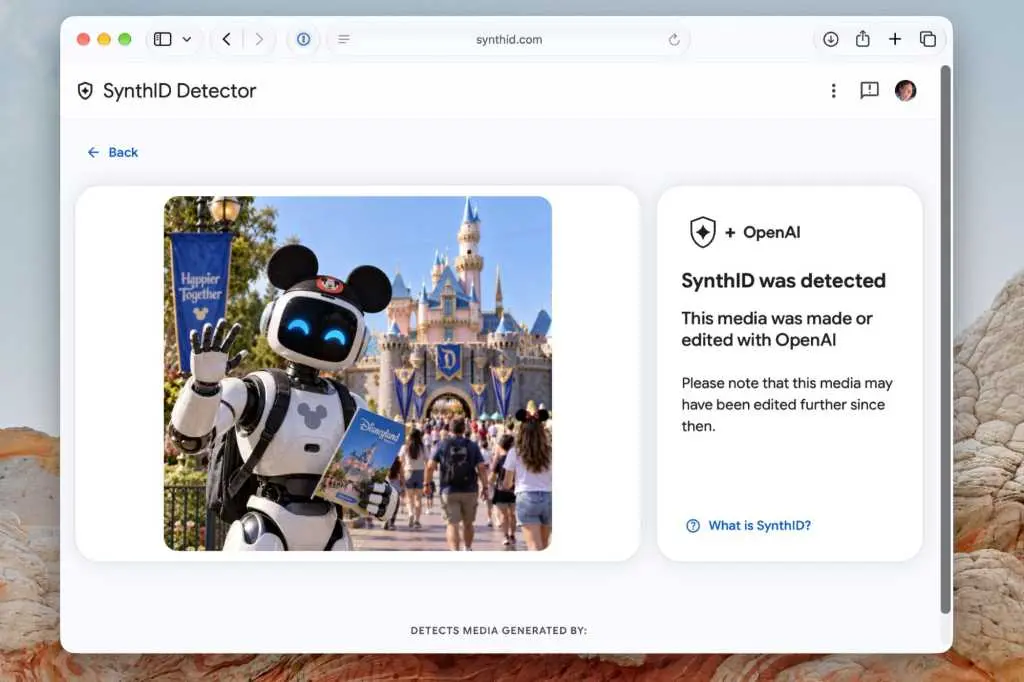
Google has released a public-facing SynthID detector designed to identify invisible watermarks in AI-generated images, video, and audio. The tool promises a way to check whether a piece of media was created by artificial intelligence. But a recent hands-on test reveals a major limitation: the detector can only confirm the presence of a SynthID watermark from a small group of partner models. If it finds nothing, that does not mean the content is real. It may simply mean the media was produced by a model that does not use SynthID, or by a partner before it adopted the technology.
What SynthID Is and How the Detector Works
SynthID is a watermarking technology developed by Google. It embeds invisible signals into AI-generated content. These signals are designed to survive common edits, such as cropping, resizing, and compression. The goal is to give AI-generated media a hidden provenance marker that can be detected later. The new detector is limited to images, video, and audio. There is a version of SynthID for text, but it is not part of this particular detection tool.
When a user uploads a file to the SynthID detector, the system scans for those embedded signals. It then returns one of two results: SynthID was detected, or no SynthID watermark was detected. That binary outcome is easy to misread. A positive result is strong evidence that the content came from an AI model that supports SynthID. A negative result is not evidence that a human made the content. It only means the detector did not find a SynthID watermark in that file.
Key Facts About the SynthID Detector
- The detector checks images, video, and audio for invisible SynthID watermarks.
- It only detects watermarks from models made by a limited set of partners, including Google, OpenAI, Nvidia, and South Korea-based Kakao.
- A negative result does not prove the media is human-made. It may have been generated by a non-partner model or before a partner adopted SynthID.
- The tool can correctly flag content from supported models, sometimes identifying which partner created it.
- Many viral AI videos and images circulating online do not carry SynthID watermarks, so the detector misses them.
- A fully reliable AI detector would require industry-wide watermarking, metadata standards, and verification tools working together.
Testing the Tool on Obvious AI Slop
To understand the detector’s real-world value, consider a simple test. Ask two popular AI models to generate images and short videos of a robot visiting Disneyland. One model may be from OpenAI, the other from Google. When those files are uploaded to the SynthID detector, the tool can quickly return a positive match. It may even report that one image came from OpenAI and the other from Google AI. That is exactly the kind of result the system was built to produce.
Now consider a different kind of test. Take a viral video that looks suspiciously AI-generated: a puppy nuzzling a baby, a man gulping soda from an overturned truck, or a row of kittens drinking from baby bottles. These clips are often shared widely on social media, and many viewers suspect they are synthetic. When such videos are run through the SynthID detector, the result is often no AI watermark detected. That does not mean the video is authentic. It means the video was not made by a supported SynthID partner, or the watermark did not survive the upload and re-encoding process, or the creator used a model that does not embed SynthID at all.
The detector itself explains this limitation in its report. It may state that it is unlikely the media was made with AI from a SynthID partner. It then adds that the content may have been generated by a non-partner organization or at a time before a partner adopted SynthID. This wording is careful, but the practical takeaway is stark: the tool cannot clear a video of being AI-generated.
Why the Partner Gap Matters
The internet is now flooded with AI slop. These are low-quality, often bizarre, emotionally manipulative, or misleading synthetic media. Some are made for engagement. Some are made for scams. Some are made simply because generative models are cheap and easy to use. The SynthID detector only covers a slice of that ecosystem. If a synthetic video comes from an unsupported model, a custom pipeline, or an older model, the detector has nothing to find.
This is not a flaw in SynthID as a watermarking method. It is a limitation of any detection system that depends on voluntary participation. Watermarking only works when the model creator embeds the signal and when the platform preserves it. If either condition fails, detection fails. AI slop often travels through social media platforms that recompress video, strip metadata, and alter files in ways that can weaken or remove watermarks. Even when a watermark is present, the detector may not see it after multiple re-uploads.
The partner list is also narrow. Google, OpenAI, Nvidia, and Kakao are important players, but they are far from the entire generative AI market. Many open-source models, smaller startups, and custom fine-tuned systems do not use SynthID. Some models are designed to remove watermarks. Others are trained on data that never included watermarking signals. As a result, the detector can produce a false sense of security. A user might upload a suspicious clip, see no watermark, and conclude the clip is real. That conclusion is not supported by the tool’s design.
What a Positive Result Can and Cannot Prove
A positive SynthID result is meaningful. It shows that the media contains a watermark from a supported partner. That is useful for journalists, researchers, platform moderators, and everyday users who want to verify provenance. If a video is labeled as generated by a specific AI model, that information can help people understand its origin. It can also help platforms label synthetic content or downrank misinformation.
But even a positive result is not a complete authenticity check. It proves that AI was involved. It does not prove that the entire file is synthetic. A watermark could be attached to a real photo that was edited with AI tools. It could be embedded in a video that mixes real footage with generated scenes. It could also be spoofed or transferred in theory, though watermarking systems are designed to resist tampering. The detector is a provenance signal, not a lie detector.
The Challenge of Building a Universal AI Detector
Many people want a single tool that can answer a simple question: was this made by AI? That tool does not exist yet. Building one would require a layered ecosystem. Watermarking standards would need to be widely adopted across model creators. Metadata standards would need to be preserved across platforms. Verification tools would need to work together across companies and borders. No single company can solve the problem alone because AI generation is decentralized and global.
Google notes that developing such a system takes time. That is an understatement. Different companies use different watermarking methods. Some use invisible signals. Some use cryptographically signed metadata. Some use both. Platforms often strip metadata for privacy or performance reasons. Open-source models can be modified to remove watermarks. Bad actors can re-encode media to break fragile signals. A universal detector would need to handle all these cases while avoiding false positives that wrongly label real media as synthetic.
There is also a privacy and trust problem. A system that can detect AI content across the internet could also be used to track creators or suppress legitimate speech. Any universal detector would need transparency, independent auditing, and clear limits. It would need to explain not just whether a watermark was found, but what that finding actually means. Without that context, users may treat a negative result as proof of authenticity, which is exactly the mistake the SynthID detector’s own FAQ warns against.
What Users Should Do in the Meantime
For now, the SynthID detector is best understood as one narrow tool in a larger toolbox. It can confirm some AI-generated content. It cannot clear everything else. When a video or image has no detectable watermark, users should look for other signs: unnatural details, inconsistent lighting, strange physics, garbled text, odd hands, or audio that does not match lip movements. These cues are not foolproof either. AI models are improving quickly, and human judgment is fallible.
The bigger lesson is that provenance and detection are not the same thing. A watermark proves where content came from. A missing watermark proves only that the signal was not found. As generative AI spreads across social media, messaging apps, and news feeds, the gap between those two facts will matter more and more. The SynthID detector is a step toward transparency, but it is not the final answer. The search for a reliable, industry-wide AI detector continues, and for now, a negative result should never be mistaken for a clean bill of health.
Source:PCWorld News