

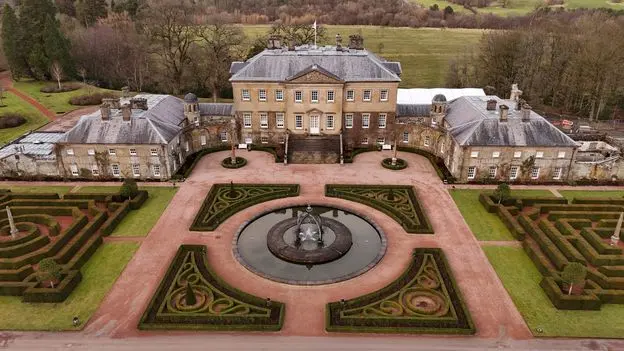
As the Royal Family's summer holiday home, Balmoral Castle is one of Britain's most famous royal attractions. But few people know King Charles III has another remarkable estate in southern Scotland. Several hours south of Balmoral, near the former mining town of Cumnock in an overlooked corner of East Ayrshire, Dumfries House hides in plain sight. Even many Scots have never visited the 2,000-acre estate, despite its grand Palladian mansion, extraordinary Thomas Chippendale collection, and sprawling gardens.
The historic estate came close to being lost forever in 2007 when the Marquess of Bute put Dumfries House on the market and its priceless contents were prepared for auction. Furniture was already being removed for transport south to London when Charles, then Prince of Wales and now King Charles III, was made aware of the imminent sale and led a £45m ($90m) rescue to save Dumfries House for the nation. As the King said at the time: "When Dumfries House's desperate situation first came to my attention I knew we had to do something to prevent a priceless treasure being lost forever."
Historical Significance and Architecture
Completed in 1759, Dumfries House was built for William Dalrymple-Crichton, the 5th Earl of Dumfries, before passing through marriage to the Marquesses of Bute. Successive owners spared no expense on the baronial pile. The building was one of the first in Scotland to have electricity, and its symmetrical design is thanks to celebrated Scottish architects Robert and John Adam. Furnishings were ordered from Thomas Chippendale in London, and 50 preserved examples of his renowned craftsmanship now sit within the manor like a career-spanning retrospective.
The grand galleries showcase paintings, antiques and pieces from its internationally significant Chippendale collection. The house features watercolours painted by the King himself, many depicting Royal Lochnagar and the mountain landscapes around Balmoral. Visitors can see 18th-Century floral carpets, Murano glass chandeliers, paintings by Sir Henry Raeburn, and a grand hall embossed with Flemish tapestries and ornate plasterwork of birds, leaves and thistles. In one sitting room alone, there is around £45m worth of antique furniture, including 38 grandfather clocks, some dating back to 1711.
The Rescue and Transformation
The rescue preserved more than a historic house and its collection. Over the next two decades, the estate became the headquarters of The King's Foundation and a testing ground for the King's ideas about heritage-led regeneration, practical education and sustainable communities. Today, visitors can tour the house, explore the 2,000-acre grounds and even stay overnight at this royal estate that remains surprisingly overlooked.
Outside, blooming Victorian walled gardens, spritzing fountains and manicured hedgerows burst with life, giving little hint the estate was once close to being dismantled. The five-acre Queen Elizabeth II Walled Garden and the arboretum, home to around 500 tree species, are popular attractions. Visitors can cross the stone Adam Bridge and an ornamental Chinese span over the Lugar Water.
Education and Community Regeneration
But the mansion and gardens are only part of Dumfries House's appeal. The estate is also the headquarters and flagship education site of The King's Foundation – the centrepiece of the King's long-held vision to revive traditional crafts, create new opportunities and help regenerate the surrounding community. Here, apprentices learn everything from stonemasonry, blacksmithing and joinery to glazing, horticulture and textile making. The campus also has a cookery school and health and wellness centre.
In a part of Scotland where opportunities dwindled following the decline of mining, the transformation has been striking. Where there was once a dearth of opportunity, there is now possibility, with around 10,000 students studying on the estate each year. The King's Foundation has stepped in to help offer a multitude of new possibilities and opportunities. Many traditional skills taught here are more sustainable and have less impact on the environment – all driven by King Charles' desire for harmony with nature.
A Model for the Future
The King's Foundation has other strategic sites across Britain, applying a similar model that combines heritage conservation with education, employment and local economic development. Five years ago, the foundation assumed stewardship of The Castle & Gardens of Mey, mainland Britain's most northerly inhabited castle in Caithness, and is busy encouraging greener tourism. Highgrove Gardens in Gloucestershire, the private residence of Their Majesties King Charles III and Queen Camilla, offers a whole curriculum of heritage, furniture and textile-making workshops for schoolchildren to post-doctoral academics.
Another enterprise is more far-flung and, perhaps, a statement of intent. Having been handed the keys last April, The King's Foundation is transforming the historic Hillview Estate in New South Wales, Australia. Using Dumfries House as its model, the charity has plans to turn the former vice-regal summer residence of the Governor of New South Wales into the first international hub for education and training programmes in heritage crafts.
Nearly two decades after it came within hours of disappearing forever, Dumfries House has become one of Britain's most unexpected royal attractions. Its grand interiors and magnificent gardens are only part of the story; beyond them is a working centre where traditional skills are being taught, preserved and passed on. What was almost lost has become, in the estate's own words, "the resurrection of a lost dream".
Source:Bbc News