

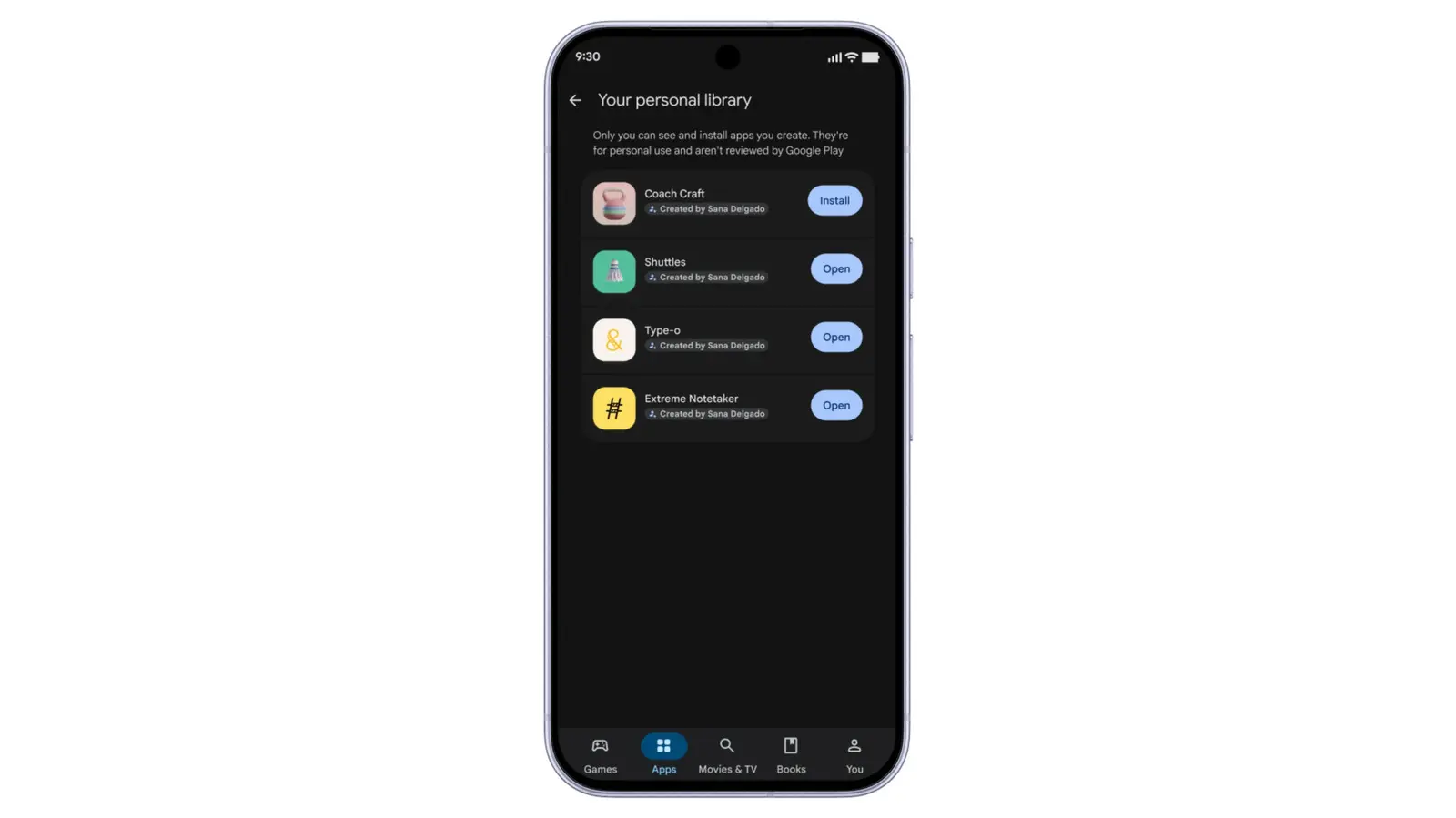
Google announced a sweeping set of Play Store changes that will allow people who build Android apps with AI tools to publish them using only a Google account. The most consequential shift is aimed at so-called vibe-coded apps: software created through natural-language prompts and light editing rather than a traditional development pipeline. Under the plan, eligible users in the United States and select other markets will be able to upload an app generated in Google AI Studio without opening a paid developer account. The rollout is limited to users 18 and older.
The change marks a significant break from the usual path to Play Store distribution, which has long required a developer account, identity checks, policy acknowledgments, fees in some cases, and app review. Google has not eliminated those steps for public distribution. Instead, it is creating an intermediate route for personal software: apps can live in a new personal library and be installed on the creator’s own devices, including tablets and computers that can access the Play Store.
Key facts at a glance
- Google will let anyone who vibe codes an Android app distribute it through the Play Store with just a Google account.
- The publishing route rolls out in the United States and select markets for users 18 and older.
- Apps can be uploaded from Google AI Studio without a paid developer account.
- AI Studio can generate apps from a written prompt to Gemini, with further prompts or direct code edits used for refinement.
- New apps initially appear only in a personal library on the creator’s own devices, including tablets and computers with Play Store access.
- Google eventually plans to let creators securely share vibe-coded apps with friends and family.
- Creators who want a global audience can graduate to a professional developer account and submit apps to normal safety reviews.
- Google is also adding AI-assisted app discovery, sports topic pages, screen-specific layouts for cars and Android XR, and a range of game features.
The personal library is the central idea. It gives AI-assisted creators a place to test and use their own software without immediately entering the public marketplace. That distinction matters because public app distribution carries different risks from private experimentation. A personal app might use sensitive permissions, access local data, or rely on generated code that has not been reviewed by anyone else. By keeping the first stage private, Google can offer a lower-friction path while preserving the review requirements that apply to apps distributed to a global audience.
How the publishing path works
Google AI Studio has become a playground for prompt-based app creation. A user can describe the kind of app they want, ask Gemini to generate it, and then refine the result with more instructions or by editing the generated code directly. That workflow has made it possible for people with limited programming experience to produce small utilities, prototypes, and experimental tools. The new Play Store route connects that workflow to Android distribution.
Until now, getting an app onto Android devices often meant either sideloading an APK or going through the formal developer process. Sideloading has been possible for years, but Google has made the process more complex over the past year, adding warnings and friction designed to protect users from malicious software. The new publishing path could reduce the need for sideloading among AI-assisted creators who want a more integrated way to install and manage their own apps. At the same time, it does not turn every vibe-coded experiment into a public product. The app begins in the personal library, and public release remains a separate step.
The graduation process is important. Google says creators who want to distribute to a global audience will be able to move to a professional developer account and submit their apps to the Play Store’s normal safety reviews. That preserves a gatekeeping layer for public apps while allowing private experimentation to happen with fewer barriers. The model resembles a ladder: a Google account gets a creator started, a personal library supports private use, and a professional account supports public distribution.
Several practical questions remain. Google has not detailed how permissions will be handled for personal-library apps, how updates will work, or what identity checks will apply before sharing expands to friends and family. The company also has not said how quickly the feature will reach additional markets or whether there will be limits on the number or size of apps in a personal library. Those details will shape how useful the route is for hobbyists, students, and small teams.
Discovery changes across the Play Store
The publishing change is part of a wider redesign of how people find apps on Android. Google already introduced Ask Play at its I/O 2026 developer conference, and it is now bringing similar discovery features to Gemini. The AI assistant will be able to surface direct links to Play Store apps inside chats, turning a conversation into a potential app-discovery surface. That could make recommendations feel more contextual, but it also raises questions about how Google ranks and labels promoted results.
Google is also expanding sports topic pages that appear in the Play Store during live matches. These pages will cover more events, including soccer games from the Premier League, Major League Soccer, and other competitions. The idea is to connect live sports moments with relevant apps, games, and content. In cars with Google built-in and on Android XR, Google is updating the Play Store layout to better fit the size of the physical or virtual screen. That reflects a broader push to make Android apps available across phones, tablets, vehicles, and extended-reality devices.
These discovery changes matter because the Play Store is no longer just a list of apps. It is becoming a recommendation engine that spans text chats, live events, and different screen sizes. For developers, that means visibility may depend on how well an app fits Google’s AI-driven recommendations and contextual surfaces. For users, it means app suggestions may appear in more places, sometimes before a traditional search begins.
Game Finder, Gamer DNA, and playlists
For people who mainly use the Play Store to find games, Google is adding a Game Finder feature that recommends titles based on individual taste. The recommendations rely on Gamer DNA, a new taste profile that users can fine-tune with preferences and favorite genres. Google has said it hopes to make filters and genre tags increasingly granular. One example raised during a press roundtable was the ability to drill down into games that specifically offer controller support.
Google is also introducing game playlists, which let users recommend a collection of mobile games for other people to try. The feature could turn discovery into a more social experience, with curated lists replacing generic charts for some users. The success of these tools will depend on how well the underlying recommendations match actual preferences. A taste profile is only useful if it can distinguish between, for example, a player who wants a short puzzle game and one who wants a competitive action title with controller support.
New tools for engagement
Google is updating the overall experience of playing games on Android as well. The Sidekick overlay now has a feature that can record 30-second clips of gameplay. That gives players a simple way to capture and share short moments without leaving the game. Developers are also receiving a collection of new tools designed to increase engagement.
These include Sprints, Community Posts, and an expansion of the Quests feature. Sprints are 48-hour in-game challenges that match players with others of a similar skill level to compete for the highest score. The format is short by design, giving players a time-limited reason to return and compete. Quests previously allowed developers to reward players with Play Points; the feature now also lets them provide in-game rewards. Community Posts adds a Q&A section to store pages so players can ask and answer questions about games in the Play Store.
Taken together, the developer tools are aimed at retention and community building. Sprints create recurring events, Quests create reward loops, and Community Posts create a direct line between players and developers. The features may be most useful for live-service games that depend on regular engagement, but they could also help smaller games build a following through time-limited challenges and store-page discussions.
Why the change matters
The broader context is the rapid spread of AI-generated software. Vibe coding has lowered the barrier to creating simple apps, but distribution has remained a separate challenge. A person can generate an app in a few prompts, yet publishing it to the Play Store has traditionally required a developer account, policy compliance, and review. The new personal-library route narrows that gap for private use, while the graduation path keeps public distribution under the existing safety framework.
The change also arrives as Google faces legal and competitive pressure to open the Play Store. Third-party app stores can now be installed through the Play Store in some markets, and regulators have pushed for more competition in mobile app distribution. By making it easier for individuals to publish AI-built apps, Google can present the Play Store as more open and more responsive to new development styles. At the same time, the company retains control over public distribution through developer accounts, safety reviews, and policy enforcement.
For developers, the most immediate effect may be a faster path from idea to installable app. A hobbyist can build a personal tool, test it on a tablet, and eventually share it with family without opening a paid developer account. For Google, the strategy could deepen reliance on AI Studio and Gemini while adding more apps and games to the Play Store ecosystem. For users, the benefit depends on whether the new apps are useful, secure, and easy to discover. The company has not said how quickly the personal library will expand beyond the initial markets, and the usefulness of the discovery and game features will depend on how well AI recommendations perform for individual users.
Source:Engadget News