

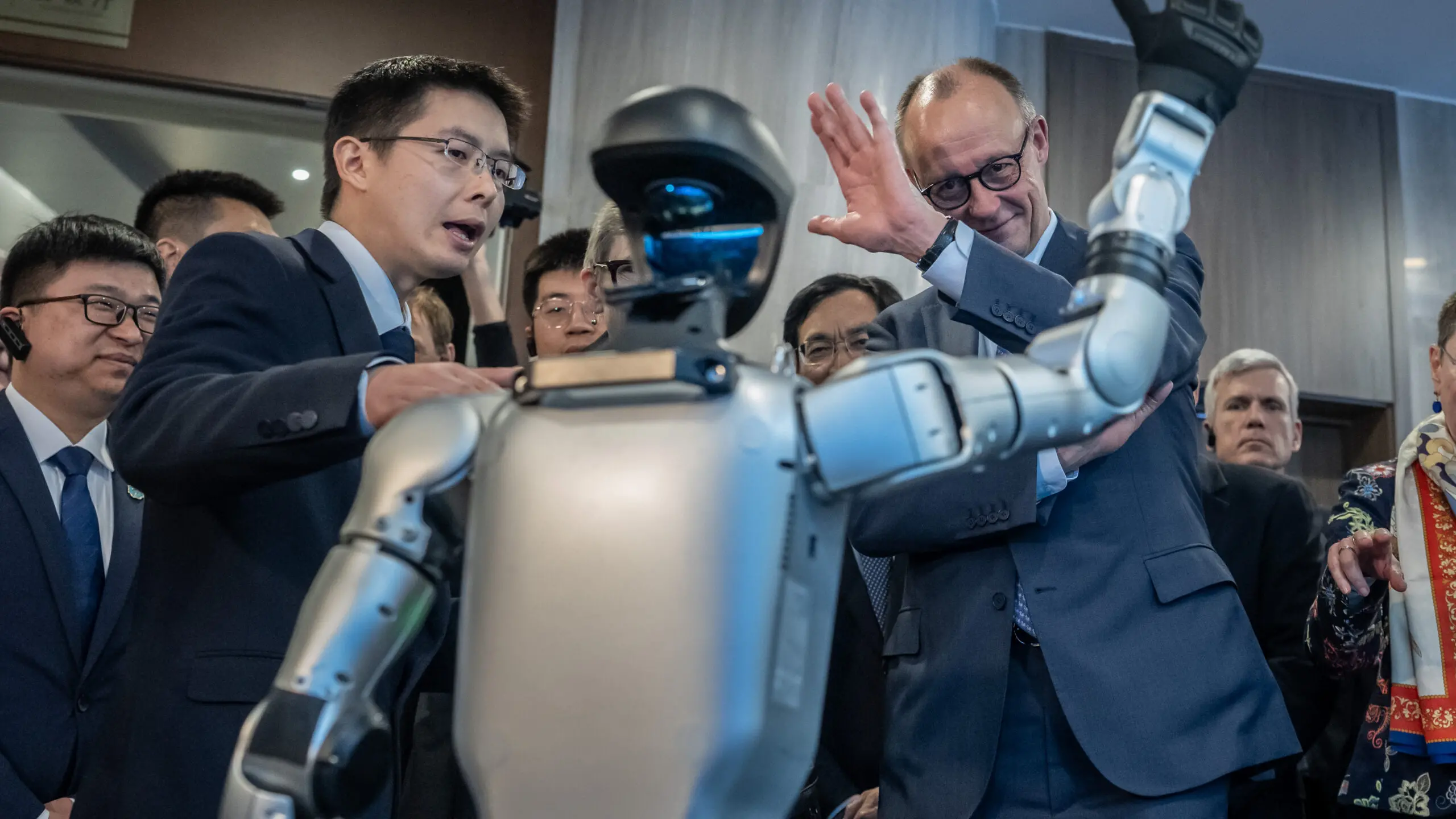
Key facts:
- Unitree Robotics founder Wang Xingxing is credited with driving the company's rise as a leading maker of low-cost humanoid and quadruped robots.
- Unitree's G1 humanoid sells for about $13,500, while the R1 is priced at $4,900.
- Employees and investors describe Wang as an extreme micromanager who approves tiny expenses and personally weighs in on product details.
- The company's IPO on the Shanghai Stock Exchange STAR Market made Wang extraordinarily wealthy but shares have fallen about 50 percent from their post-listing peak.
- Unitree faces quality-control concerns, high attrition, growing competition, and new US import restrictions on foreign-made robots.
A founder's cost-cutting obsession
Unitree Robotics has become one of the most visible names in the global robotics industry by doing something that few humanoid robot makers have managed: selling walking machines at prices that are almost consumer-friendly. The company's founder, Wang Xingxing, built Unitree from a hardware engineering background into a firm that now competes with some of China's largest tech manufacturers. His central operating principle, according to interviews with employees and investors, is an almost relentless focus on cost.
That focus shows up in the company's product lineup. A baseline Unitree G1 humanoid robot designed for developers and researchers sells for $13,500 before shipping. The Unitree R1, aimed at more casual users and hobbyists, is priced at $4,900. Those numbers are far below the six-figure sums often associated with humanoid robots from Western and Japanese companies. Robotics hardware engineers say Unitree achieved its cost advantage through careful design choices and structural engineering, not simply through cheap labor. The company has rethought components, materials, and assembly methods to strip out expense while keeping robots functional.
Wang, an introverted founder with a background in hardware structural engineering, also appeared at a 2025 business symposium hosted by Chinese President Xi Jinping, a sign of his rising profile. Unitree launched an initial public offering on the Shanghai Stock Exchange STAR Market on August 19, making Wang extraordinarily wealthy. But the company's success has been driven by a leadership style that may be better suited to a small startup than a fast-growing robotics firm.
Wang's attention to detail is legendary inside the company. He is said to personally decide nearly every aspect of corporate strategy and product design, down to the colors of materials and the lengths of individual screws. That level of involvement helped Unitree move quickly in its early years, when it was a small startup trying to prove that legged robots could be built at a fraction of traditional costs. But as Unitree has grown, the same habits have created bottlenecks. Employees describe having to queue up to get decisions from Wang, who remains in the office most of the time, including weekends.
Micromanagement and a penalty-heavy culture
Wang reportedly embodies the stereotype of the hard-charging tech founder. He still posts in work chats at 2 or 3 a.m. and communicates bluntly, cutting employees off after a few sentences if he thinks a discussion is not business-focused. His control extends to expenses: one employee said Wang personally approves any reimbursement request above 100 yuan, or roughly $15. That practice may have helped preserve cash in the startup phase, but Unitree now has at least 480 employees, according to public reports, and the founder's personal review of tiny costs can slow down routine operations.
The company's incentive system is also described as unusually punitive. Employees claim that penalties are far more common than rewards, and that workers compare who receives less criticism rather than who receives more praise. Wang reportedly gave every senior executive a performance score of 1 on a scale from 0 to 1.5. One longtime employee said the company experienced the highest attrition of core staff in its history in 2025 and 2026. Such turnover can be especially damaging for a robotics company, where institutional knowledge about hardware tolerances, supply-chain relationships, and software integration is hard to replace.
Unitree has not responded directly to the specific allegations. The company later issued a broad statement to Chinese media calling the reporting substantially inaccurate without providing details. Regardless of the dispute, the picture that emerges from interviews is of a company whose culture is tightly tied to one person's habits and priorities.
Quality control and the cost of cheap robots
Unitree's cost discipline has delivered affordable robots, but it has also created trade-offs. Employees described the company's early robots as having an extremely high rate of returns for repairs. That has supposedly improved over time, with current machines able to survive their one-year or six-month warranty periods without breaking down. Even so, the transition from a repair-heavy startup to a reliable manufacturer is a critical test for any hardware company. Customers who buy robots for research or education may tolerate some quirks, but industrial and commercial buyers expect durability and predictable maintenance.
The company's main customers remain universities and research institutions. Industrial uses of humanoid robots are still generally being tested in smaller pilot deployments. That customer base has helped Unitree grow, but it also limits revenue diversity. If the company wants to scale beyond research labs, it will need to prove that its low-cost design philosophy does not come with hidden costs in reliability, service, and safety.
The AI pivot and the physical intelligence race
Wang has previously expressed skepticism about large world models, arguing that they are too compute-intensive for practical robotics. But during Unitree's recent IPO, he spoke about the company's attempts to use large AI models as the foundation for a type of physical AI. The goal, he suggested, is an autonomous loop of perception, decision, execution, evaluation, learning, and evolution. That ambition places Unitree in direct competition with other robotics companies trying to combine advanced AI with affordable hardware.
The shift matters because humanoid robots are only as useful as their software. A cheap robot that cannot navigate a cluttered room, manipulate objects, or recover from a fall is little more than a demo. If Unitree can pair its cost advantage with reliable autonomy, it could broaden its market beyond universities. If it cannot, competitors with stronger AI stacks may erode its lead even if their hardware is more expensive.
China's robot ambitions and global pushback
Unitree is not growing in a vacuum. China's government has made robotics a strategic priority, and the country benefits from a deep supply chain for electronics and electric vehicles. In July, China's Ministry of Industry and Information Technology said it expects the country to manufacture more than 100,000 humanoid robots in 2026. That would be a significant increase from just 14,000 humanoid robots produced worldwide in 2025, most of them in China. Unitree competes with other Chinese companies such as AgiBot Robotics and UBTECH, all of which are trying to scale manufacturing and attract customers.
Government support has helped Chinese robotics companies move quickly, but it has also raised concerns about overcapacity and hype. After the investor frenzy around Unitree, Chinese regulators gave informal guidance suggesting that future IPO approvals would be reserved for humanoid robot companies that can generate recurring revenue or are at least on a path to reducing losses or achieving real innovation. That guidance signals that Beijing wants credible businesses, not just compelling prototypes.
At the same time, the United States government banned imports of foreign-made robots as of July 28, including humanoid robots and robot dogs made by Chinese companies. The decision prevents US universities and tech companies from purchasing Unitree's newest robots for research purposes and has forced the leading US distributor of Unitree's robots to pivot to domestic manufacturing. The import ban could slow Unitree's access to American research customers, though it may also accelerate domestic robot efforts in the United States.
Unitree's IPO buzz has cooled as shares fell 50 percent below their post-listing peak, putting the company's market valuation around $30 billion. That decline reflects broader questions about the commercial viability and practical usefulness of humanoid robots. Unitree has achieved profitability, which is rare in the sector, but its dependence on research customers and pilot industrial deployments leaves room for doubt.
Can the founder's playbook scale?
Wang's leadership style may have been an advantage when Unitree was small and needed to out-engineer larger rivals on a tight budget. The same approach becomes riskier as the company grows. Micromanagement can slow decision-making, penalty-heavy incentives can drive away talented engineers, and a focus on cost can undermine quality if not balanced with investment in testing and service. Unitree's competitors are also scaling, and some are backed by larger corporate parents or deeper pockets.
The next phase for Unitree will test whether its founder's obsession with cost and detail can evolve into a repeatable management system. The company has already shown that cheap humanoid robots are possible. The harder question is whether they can be reliable, profitable, and widely useful. As regulators, competitors, and foreign governments adjust, Unitree's ability to answer that question will determine whether its early lead becomes a durable advantage or a cautionary tale about the limits of one person's control.
Source:Ars Technica News