

The 1960s are often remembered for the space race, shifting pop culture, and deep social change, but the decade also produced an extraordinary run of foundational technology. Many of the devices and systems that people rely on today began as experimental prototypes, military projects, or industrial tools more than half a century ago. The modern smartphone, the internet, streaming media, self-driving cars, and even the humble computer mouse all trace part of their lineage to work done in the 1960s.
What makes these inventions so important is not that they looked like today’s products. Most were bulky, expensive, limited, or aimed at specialized users. Their significance lies in the ideas they proved: that light could be concentrated into a controllable beam, that machines could be programmed to perform industrial work, that memory could be condensed onto a semiconductor, and that computers could talk to one another across distance. Each breakthrough became a building block for later generations of engineers.
Key Facts at a Glance
- Lasers: The first working laser was demonstrated in 1960; lasers now support medicine, communications, barcode scanning, printing, and lidar.
- Industrial robots: Unimate began work at General Motors in 1961, becoming the first industrial robot and paving the way for automated manufacturing.
- LEDs: Practical semiconductor LEDs emerged in 1961, with commercial infrared versions arriving in 1962 and visible red LEDs following soon after.
- Cassette tapes: Philips introduced the compact cassette in 1963, making portable recorded music a mass-market possibility.
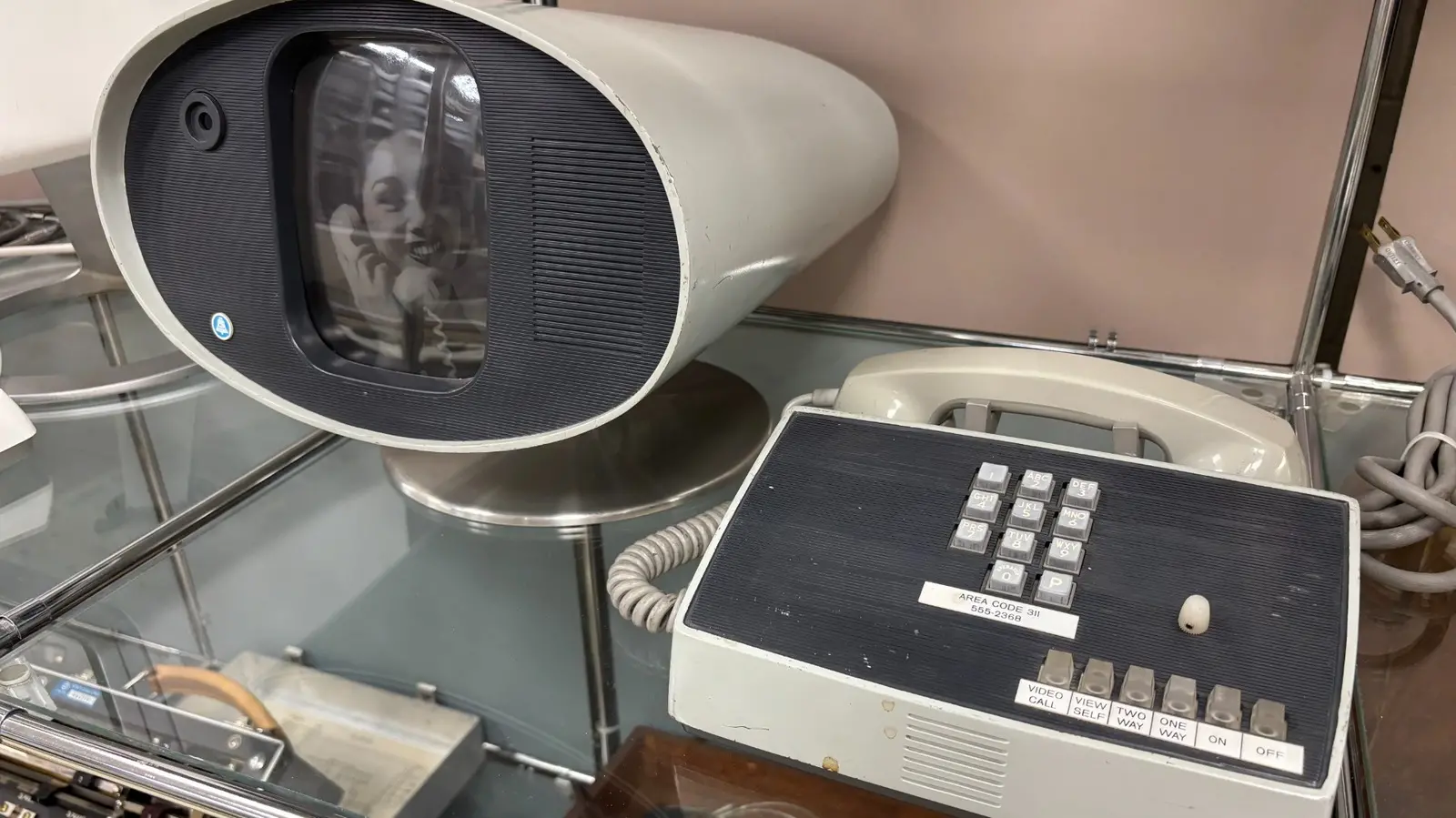
- Picturephone: Bell Labs demonstrated video calling at the 1964 New York World’s Fair, decades before FaceTime and Zoom.
- Computer mice: Doug Engelbart conceived the mouse in 1961, and a prototype was built in 1964.
- Touchscreens: A capacitive touchscreen was developed in 1965 for British air traffic control, with later advances at CERN in 1972.
- DRAM: Robert Dennard invented dynamic random-access memory in 1966, reducing memory cells to a single transistor.
- Apollo guidance software: Margaret Hamilton’s team created revolutionary flight software and helped establish software engineering as a discipline.
- The Brown Box: Ralph Baer’s 1967 prototype led to the Magnavox Odyssey and the first generation of home video game consoles.
- ARPANET: The first connected computers came online in 1969, laying the groundwork for the internet.
- UNIX: Created at Bell Labs in 1969, UNIX became a portable operating system whose influence reached macOS, iOS, Android, and Linux.
Lasers
Laser stands for light amplification by stimulated emission of radiation, a concept Albert Einstein helped theorize long before anyone built a working device. The first successful laser was demonstrated in 1960, and it quickly captured the public imagination as a futuristic beam weapon. Real lasers did not destroy planets or spaceships, but they became far more useful in ordinary life than science fiction might have predicted. They are now used in surgery, cutting and welding, telecommunications, barcode scanners, laser printers, optical drives, and lidar systems for self-driving cars. Fiber-optic internet depends on lasers to carry data at high speeds, which means even people who never touch a laser pointer still benefit from the technology.
Robots
Automata and mechanical figures have existed for centuries, but the modern industrial robot arrived in a very specific form. The first programmable robot was conceived in the 1950s, and by 1961 a commercial version called Unimate began working for General Motors. Installed at a plant in New Jersey, the robotic arm removed hot metal parts from die-casting machines. It was a simple task by today’s standards, but it proved that programmable machines could perform dangerous, repetitive industrial work. Unimate helped launch the field of industrial robotics, which now supports automobile manufacturing, electronics production, warehousing, and military systems. Consumer robots and robotic dogs are later descendants of the same basic idea: a machine that can sense, move, and execute programmed instructions.
LEDs
Light-emitting diodes are so common today that they seem ordinary, but practical semiconductor LEDs were a major 1960s achievement. The first commercial LED, developed in 1962, emitted infrared light and was sold as the SNX-100. Visible red LEDs followed, and by the 1970s the technology became cheaper and gained more colors. LEDs appeared in alarm clocks, calculators, and digital watches, including early watches that used red LEDs to display time. Over time, LEDs became brighter, more efficient, and inexpensive enough for use in billboards, jumbotrons, televisions, and household bulbs. Modern LED lighting can use up to 80 percent less energy than traditional incandescent bulbs, making it one of the most consequential consumer applications of the technology.
Cassette Tapes
The compact cassette was introduced by Philips in 1963 at the Berlin Radio Show. It was an evolution of magnetic tape recording, which had existed since the late 1920s, but the cassette made tape smaller, more portable, and easier to use. Cassettes became the primary way many people listened to music on the go, whether through a car stereo, a boombox, or a Walkman. They also played a role in early home computing, storing and loading programs on systems such as the Commodore 64. Before cassettes, portable music was largely limited to radio. Tapes introduced a low-cost, portable format that helped grow the music-player industry, eventually giving way to CDs, MP3s, and today’s streaming services.
The Picturephone
Video calling feels like a 21st-century convenience, but its roots reach back to 1964. Bell Labs demonstrated the Picturephone at the New York World’s Fair, showing a working commercial product capable of live video calls between Picturephone units. The system was technically impressive for its time, but it was expensive to rent, operate, and use. In 1970 it became available in two cities, yet it never achieved commercial success. Even so, the Picturephone proved that live video communication was possible. Modern apps such as FaceTime, Zoom, and Teams are far more advanced and affordable, but they follow a path that the Picturephone helped open.
Computer Mice
The computer mouse is so familiar that few people think about its origins. Doug Engelbart conceived the device in 1961 during a lecture and later patented a design with rolling wheels, a wooden box, and a single red button. By 1964, Bill English at the Stanford Research Institute had built the first prototype. The device was named for its shape and cable, which made it look like a mouse with a tail. As computing moved from text commands to graphical interfaces, the mouse became an essential tool. Modern mice add wireless connectivity, scroll wheels, extra buttons, haptic feedback, and RGB lighting, but they still perform the same fundamental task: helping a person interact with a graphical display.
Touchscreens
Touchscreens also emerged in the 1960s. A capacitive touchscreen was invented in 1965 as a way to improve air traffic control in the United Kingdom. The early system used copper wires connected to circuits; when a finger touched the wire, the system detected contact and executed commands. That technology remained in use in the U.K. until 1995. CERN developed a more practical touchscreen for complex applications in 1972, and further advances followed. Modern touchscreens support multi-touch, pressure sensitivity, stylus input, and even fingerprint sensing embedded beneath the display. Anyone reading on a smartphone or tablet is using a distant descendant of that 1960s air-traffic-control innovation.
DRAM
Dynamic random-access memory, or DRAM, is one of the hidden pillars of modern electronics. Robert Dennard invented it in 1966 while working at IBM. Earlier memory systems were large and expensive, often using six transistors to store a single bit of information. Dennard reconfigured the process to use a single transistor, creating a semiconductor memory architecture that transformed computing. DRAM temporarily stores active application data, background processes, and operating system tasks, helping computers run efficiently. It is found in smartphones, laptops, game consoles, digital cameras, and countless other devices. Without DRAM, modern computing would be slower, larger, and far more costly.
The Apollo Program’s Guidance Software
The Apollo program needed software capable of guiding astronauts to the Moon and back, and the team led by Margaret Hamilton produced something revolutionary. Hamilton’s work helped coin the term software engineer, and her team’s code was woven into the Apollo Guidance Computer’s memory. The software had to be reliable, compact, and capable of recovering from errors. That focus on error recovery and asynchronous software became foundational to modern programming. Apollo guidance software influenced fly-by-wire systems in aircraft and established practices that remain important in aerospace, computing, and safety-critical systems. The image of Hamilton beside stacks of printed code has become a symbol of software engineering’s origins.
The Brown Box
Before the PlayStation 5 or the Nintendo Switch, there was the Brown Box. Developed in 1967 by Ralph Baer and his colleagues, TV Game Unit 7 was a prototype designed to test multiplayer, multiprogram gaming. The wooden box was rudimentary, but it included two controls and could play more than one game. Program cards and switches told the system what to display, and the available games included simple versions of ping-pong, checkers, golf, and a lightgun game. Magnavox purchased the technology and released the Magnavox Odyssey in 1972, launching the first generation of home video game consoles. The Brown Box is therefore a direct ancestor of today’s massive video game industry.
The ARPANET
The World Wide Web arrived in 1989, but the internet itself began earlier with ARPANET. The Advanced Research Projects Agency, the predecessor to DARPA, created the Advanced Research Projects Agency Network to connect computers for communication and resource sharing. The first connected computers came online in 1969. Initially, ARPANET linked universities and government computers, but it expanded over time. Email, internet relay chat, and other capabilities emerged in the 1970s. ARPANET ceased to exist in 1990, but for decades it was the central experimental network that made long-distance computer communication practical. It gave birth to the internet that now supports commerce, streaming, social media, and global data sharing.
UNIX
UNIX was created in 1969 at Bell Labs by Dennis Ritchie and Ken Thompson. It was designed to be portable and adaptable, able to run on different kinds of computers rather than being tied to a single machine. That open design helped UNIX spread across industries and research institutions, and it became one of the most influential operating systems ever built. Its influence can be traced through macOS, iOS, Android, and Linux, and even Windows adopted some UNIX-inspired ideas over time. Ritchie and Thompson were inducted into the National Inventors Hall of Fame in 2019 for their work. UNIX’s portability and open architecture became a lasting template for the operating systems that followed.
Source:SlashGear News