

Zelenskyy Dismisses Russian Capture Claims as Propaganda
Ukrainian President Volodymyr Zelenskyy has categorically denied recent Russian claims that their forces have captured the strategically important town of Kostiantynivka in the Donetsk region. In a statement on social media, Zelenskyy called the assertion "another lie" manufactured by the Kremlin to generate headlines and sustain the narrative of Russian battlefield success.
The Russian presidency had earlier announced that President Vladimir Putin met with military commanders on Friday and was briefed on the taking of Kostiantynivka, a town that has been a focal point of intense fighting. Putin reportedly reaffirmed his determination to continue the invasion. However, Ukrainian officials maintain that the town remains under their control and that Russian forces have not advanced as claimed.
Kostiantynivka sits along critical supply lines and has been a key defensive position for Ukrainian forces in the eastern theatre. Its capture would theoretically give Russian troops a logistical advantage, potentially opening a corridor toward the city of Kramatorsk. The conflicting reports underscore the information war that has accompanied the kinetic conflict since February 2022.
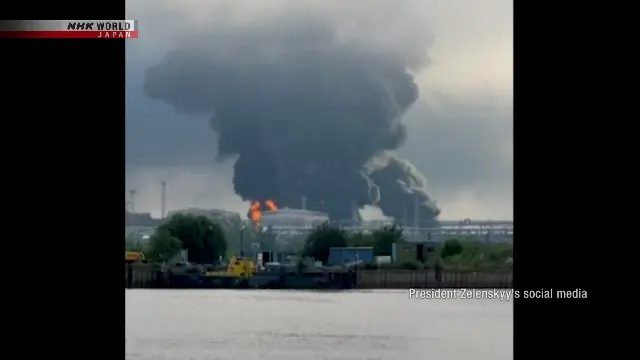
The Ukrainian president took the opportunity to highlight a successful retaliatory strike deep inside Russian territory. According to Zelenskyy, Ukrainian drones struck oil infrastructure and a military facility near St. Petersburg, Russia's second-largest city. He released footage showing flames and smoke rising from the target area. The strike location was more than 850 kilometres from the Ukrainian border, demonstrating Kyiv's growing ability to project power far beyond frontline areas.
Background on the Donetsk Region and Kostiantynivka
The Donetsk region has been a primary battleground since Russia launched its full-scale invasion. Pro-Russian separatists had already controlled parts of the region since 2014, but the 2022 offensive dramatically expanded the front line. Towns like Bakhmut, Avdiivka, and now Kostiantynivka have seen some of the war's heaviest urban combat. Control over these settlements is often temporary, with positions changing hands after brutal attritional fighting.
Kostiantynivka lies approximately 20 kilometres west of Bakhmut, which fell to Russian forces in May 2023 after months of siege. Since then, Russian troops have pushed westward, aiming to secure the entire Donetsk oblast. Ukrainian defenders have repeatedly stalled these advances through dug-in defences and counterattacks. The town's pre-war population of around 70,000 has dwindled to a few thousand civilians, many of whom have refused to evacuate despite constant shelling.
Western military analysts have noted that Russian claims of capturing towns often precede actual control by days or weeks, as Moscow seeks to project progress before it is fully consolidated. The Institute for the Study of War (ISW) has documented multiple instances where Russian state media announced victories that later proved premature or exaggerated. Zelenskyy's denial aligns with this pattern and aims to counter the narrative that Ukraine is losing ground.
Long-Range Ukrainian Strikes Deepen Pressure on Russia
The attack near St. Petersburg marks one of the deepest Ukrainian strikes inside Russia since the war began. While Kyiv has regularly targeted oil depots, refineries, and military installations in border regions such as Belgorod and Kursk, hitting a site so far north represents a significant escalation in range and capability. Ukrainian officials have not disclosed the exact type of drone used, but analysts believe domestically produced models like the 'Liutyi' or 'Bober' could achieve such distances.
St. Petersburg is a symbolically important city, the birthplace of modern Russia under Peter the Great and a major economic hub. Striking near its outskirts sends a clear message that nowhere in Russia is safe from Ukrainian retaliation. The targeted infrastructure likely supports Russian military logistics, including fuel supplies for the Baltic Fleet and forces deployed in Ukraine. Previous Ukrainian strikes on Russian oil infrastructure have forced Moscow to divert resources to air defence and firefighting, straining its war economy.
Zelenskyy's decision to publicise the attack serves multiple purposes: it boosts domestic morale, demonstrates to Western partners that Ukraine is actively fighting beyond its borders, and warns Russian citizens that the war's costs are not limited to the front line. The imagery of fire and smoke near a major city also undermines the Kremlin's portrayal of a calm and unaffected homeland.
International Reactions and Military Implications
The United States and European Union have consistently supported Ukraine's right to defend itself, including striking legitimate military targets inside Russia, while cautioning against attacks that might escalate the conflict. The Biden administration has supplied long-range ATACMS missiles, though these have been used primarily within occupied Ukrainian territory. Ukraine's indigenous drone programme, however, has given it an asymmetrical capability that is harder for Russia to counter.
Russia has condemned the strikes as acts of terrorism and vowed retaliation. On Saturday, Russian air defence systems reported shooting down multiple drones over several regions, including Leningrad Oblast where St. Petersburg is located. The frequency of such attacks has increased in recent months, suggesting that Ukraine is ramping up production and diversifying its strike portfolio.
For the Donetsk front, the denial of Kostiantynivka's capture means the situation remains fluid. Ukrainian forces continue to hold defensive lines while launching local counterattacks to regain tactically advantageous positions. The Russian military command faces pressure to demonstrate tangible gains ahead of the second anniversary of the war, which may explain the premature claims. However, Western intelligence assessments indicate that Russian offensive operations have slowed due to casualties and logistical constraints, giving Ukraine time to prepare its own operations later this year.
Economic and Humanitarian Toll
The prolonged war has devastated the Donetsk region. Infrastructure is shattered, industries have ceased, and hundreds of thousands have fled. Those who remain endure daily shelling, shortages of water and electricity, and constant fear. Humanitarian organisations struggle to deliver aid due to security risks and Russian restrictions on access to occupied areas.
On the economic front, both sides are feeling the strain. Russia has increased defence spending to a record 30% of its budget, leading to domestic inflation and labour shortages as men are drafted or leave to avoid mobilisation. Ukraine relies heavily on Western financial aid, which has faced political hurdles in the US Congress and the EU. The ability to strike Russian oil infrastructure could disrupt Russia's export revenue, indirectly benefiting Ukraine's economic resilience.
Zelenskyy's latest statements underscore his strategy of maintaining international attention and domestic unity. By publicly rejecting Russian claims and showcasing successful counterstrikes, he aims to keep the war's reality in the spotlight. The coming weeks will reveal whether the denial of Kostiantynivka's capture is borne out on the ground or if Russia can eventually translate its claims into territorial gains. For now, the fight for Donetsk continues, and the information battle rages alongside it.
Source:NHK WORLD News