

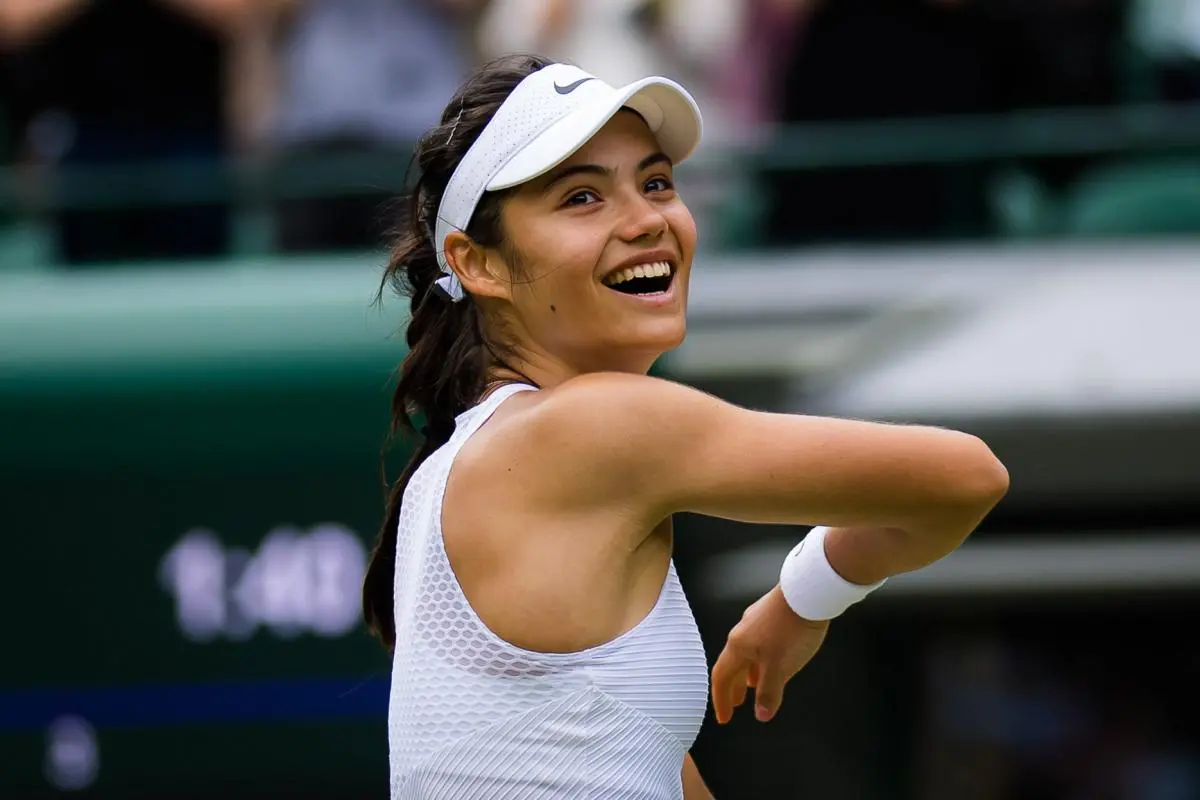
Emma Raducanu, the 18-year-old British tennis prodigy, captured the imagination of the sporting world when she stormed into the fourth round of Wimbledon in 2021. Playing in her first main draw at the All England Club and just three weeks after making her WTA debut, Raducanu turned heads with her composure, athleticism, and fearless shot-making. Ranked 338th in the world at the time, she was given a wildcard into the tournament and made the most of it, becoming one of the stories of the fortnight.
Born on November 13, 2002, in Toronto, Canada, to a Romanian father and a Chinese mother, Raducanu moved to England at a young age. Her multicultural background has often been cited as a source of strength, giving her a broad perspective and a deep well of determination. She began playing tennis at the age of five, and her talent was quickly apparent. She trained at the Bromley Tennis Centre under the guidance of coach Nigel Sears, who had previously worked with British star Johanna Konta. Raducanu's junior career was impressive: in 2018, she reached the quarterfinals of the girls' singles at Wimbledon and later climbed to a career-high junior ranking of 20. However, injuries and the COVID-19 pandemic slowed her progress, and she had to wait until June 2021 to play her first WTA tournament in Nottingham, where she lost in the first round.
Her run at Wimbledon began with a straightforward 6-4, 6-4 victory over Vitalia Diatchenko in the first round, followed by a three-set thriller against Markéta Vondroušová, a former French Open finalist. Raducanu's ability to stay calm under pressure, coupled with her pinpoint groundstrokes and powerful serve, earned her a third-round match against the experienced Sorana Cîrstea. She dispatched Cîrstea 6-3, 7-5, showcasing not only her technical prowess but also her tactical intelligence. The crowd at Court 1 roared with every winner, sensing the emergence of a new star. The British media immediately began comparing her to another teenage sensation, Emma Raducanu drew comparisons to former Wimbledon champion Andy Murray, though with a distinct style of her own.
Her journey to the fourth round was remarkable for multiple reasons. First, the sheer speed of her ascent: from a junior making her way through qualifying events to a grand slam third-round winner in a matter of weeks. Second, the context of the COVID-19 pandemic, which had disrupted live sports and deprived young players of critical developmental tournaments. Raducanu had spent much of 2020 and early 2021 training and playing on the ITF circuit, building her game away from the spotlight. Her breakthrough at Wimbledon underscored the depth of British tennis talent, following in the footsteps of players like Jo Konta and Tim Henman, who also captured the nation's heart.
Beyond the immediate headlines, Raducanu's success raised important questions about the future of women's tennis. The sport had been craving new stars to challenge the dominance of the established elite like Ash Barty, Iga Świątek, and Simona Halep. Raducanu's game, characterized by clean ball striking, quick footwork, and a mature understanding of court geometry, suggested she had the potential to join that group. Her results at Wimbledon also earned her a place in the history books: she became the youngest British woman to reach the fourth round since Laura Robson in 2013, and the lowest-ranked player to do so in the tournament's history.
To understand her achievement, one must look at the physical and mental demands of Grand Slam tennis. Raducanu had never played a best-of-three match at this level before Wimbledon, yet she adjusted rapidly, winning matches that required both endurance and mental fortitude. Her serve, often clocked at over 110 mph, was a key weapon, but it was her return game that truly stood out. She read opponents' serves well and could redirect pace with ease, forcing rallies on her own terms. Her ability to hit winners from both wings, combined with a willingness to come to the net, made her a versatile opponent.
Off the court, Raducanu handled the sudden media scrutiny with poise beyond her years. In post-match interviews, she spoke about staying grounded, focusing on each point, and enjoying the experience. Her parents, who had driven her to countless practices and tournaments as a child, were in the stands, watching with tear-filled eyes. She credited them with instilling in her the discipline and humility that defined her approach to the sport. This humility, coupled with her obvious talent, made her an instant fan favorite.
Biographically, Raducanu's story is a testament to the power of perseverance. After years of grinding on the ITF circuit, often playing in front of sparse crowds and dealing with travel logistics on a limited budget, she had finally found the stage she deserved. Her wildcard into Wimbledon was not merely a gift but a recognition of her potential. The Lawn Tennis Association, which had been working to revive British tennis, took note of her progress and offered her opportunities to train with top players and coaches. This investment paid off spectacularly during that June fortnight.
The fourth-round match against Ajla Tomljanović was a step too far for Raducanu at that time. She lost 6-2, 6-7(3), 1-6, but not before fighting valiantly and showing glimpses of the champion she would later become. During the second set, she suffered from breathing difficulties and called for the trainer, but she found the strength to win that set and force a decider. Though she ultimately fell short, the experience was invaluable for her development. She left Wimbledon with a ranking boost, a wildcard for the US Open qualifying, and the attention of the entire tennis world.
Raducanu's performance also highlighted the changing demographics of tennis. As a player of Chinese and Romanian heritage representing Great Britain, she embodied the multicultural mosaic of modern Britain. Her success resonated with diverse communities, inspiring young girls from similar backgrounds to take up the sport. The media coverage praised not only her tennis but also her intelligence and maturity. A girl who had been studying for her A-levels just months earlier was now a household name. She balanced her education with tennis, earning strong grades while pursuing a professional career, a choice that demonstrated her focus and long-term vision.
In the months following Wimbledon, Raducanu continued her rise, winning a WTA Challenger event in Chicago and then stunning the world by winning the US Open as a qualifier. That victory made her the first qualifier ever to win a Grand Slam title and cemented her status as a global superstar. The run at Wimbledon was the first chapter in a story that would capture the imagination of sports fans everywhere. But in the moment, at the peak of the 2021 grass court season, she was simply a young player fulfilling a dream, playing brilliant tennis in front of adoring crowds, and introducing a new generation to the magic of Wimbledon.
Source:L'Équipe News