

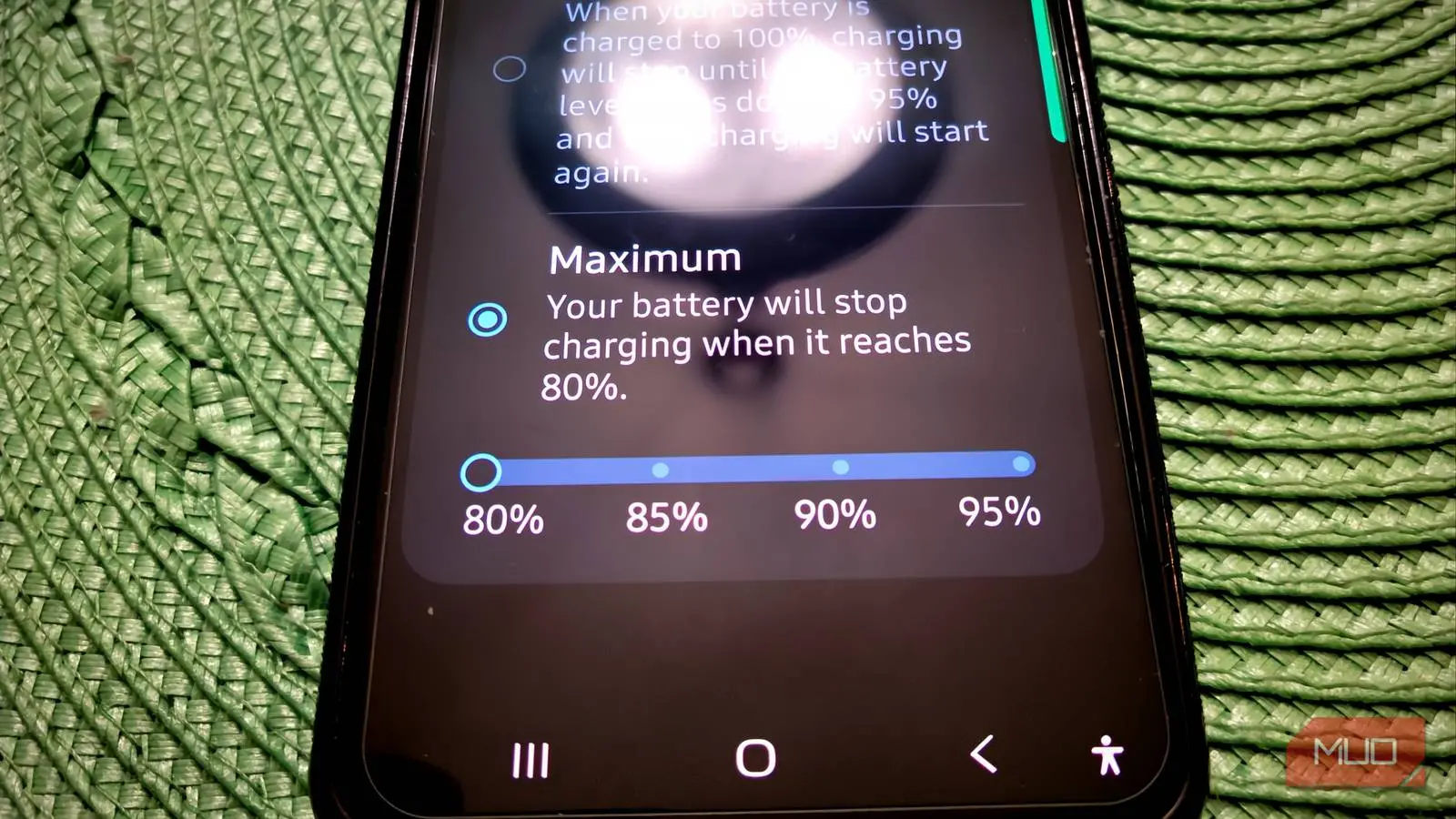
Over a year ago, a user started capping their phone's battery at 80% charge, and they admit there were days they second-guessed the decision. The real issue was that it felt like the phone died too quickly for something that might never yield results. However, they were wrong; it produced real results, and they know this because a family member decided not to use the same feature on the identical model, and the differences are glaring.
Stop Your Phone from Charging All the Way
A Full Battery Wears Out a Lot Faster
Before doing anything else with a phone, it's worth setting up one thing that'll protect the battery for the long haul. Regardless of what users may think, every lithium-ion battery is basically a consumable. That means it's going to wear down over time, no matter what you do. The time it takes to become useless depends a lot on the environment it lives in and how you charge it day to day. A phone might be a powerhouse, but its battery is still subject to the same chemistry as any other lithium-ion cell, and pushing it too hard for too long will erode its capacity and performance.
That's why it makes sense to set this up on day one, before charging habits even have a chance to start doing damage. However, it's never too late to start, and the user did not start doing this until years after buying the phone. Taking control of how a phone charges right from the start means heading off a lot of that wear before it ever happens, and the battery will simply last longer as a result.
What to do is go to the battery health settings and enable the option that stops charging at 80%. The idea is to keep the battery out of that high-voltage zone it hits when you push it all the way to full. Normally, charging to 100% means the battery is sitting at somewhere between 4.20 and 4.35 volts per cell, which is great for squeezing out every bit of runtime, but rough on the battery itself. That last stretch, from 80% to 100%, is the hardest part of the whole charge. You are basically cramming lithium ions into a space that is already nearly full, and that generates extra heat the battery doesn't need. Sitting at that high voltage for any length of time speeds up the unwanted chemical reactions going on inside that are actively killing the battery. If you cap it at 80% instead, you are sidestepping most of that voltage-driven stress. Do that consistently, and you could double, maybe even quadruple, how many charge cycles your battery has in it.
If you have an iPhone 15 or newer running iOS 18, just open Settings, go to Battery, tap Charging, and pick the 80% charge limit option. On Android, go to Settings, then Battery, then Battery Health and Charging Optimization, and flip on 'Limit to 80%.' Galaxy users can do the same thing through Settings, then Battery, then Battery protection, where you choose the option that caps things at 80%. You can go higher, but just keep in mind that it is a trade-off. The more you add, the more damage you could do over time.
How the Phone Held Up After Five Years
You'll Have to Get Used to Charging It Mid-Day
The user has been capping their phone's battery at 80% for over a year, and for a few years before that, they tried other settings too. It is not something you get used to quickly. At first, the hardest part was just remembering that 80% is done. Unplugging the phone and seeing it already sitting at 20% below full took some getting used to. On busier workdays, the user could really feel the difference in how much screen time they had left by the afternoon, so they started keeping a charger near their desk and charging the phone much sooner than they normally would. Before, the phone would hit 15% by the end of the night. Now, since they charge it in the middle of the day, it still has a good deal of charge before bed.
That is also annoying if you forget to charge it regularly in the middle of the day. You are giving up that extra cushion of battery, and for the first few months, it genuinely felt like the phone had been turned into a slightly weaker version of itself on purpose. A family member bought the same phone as the user did on the same day, but they did not adopt the 80% cap. The user started messing with the battery settings around the second to third year. At this point, the family member's phone needs to be replaced; it gets hot all the time, has Wi-Fi issues, and takes much longer to charge than the user's phone. The user's phone still feels pretty new. The user used to roll their eyes at the thought of one setting making a phone last longer. However, it is completely true in this case. The user and the family member have the same type of case, and the family member's phone's back, where the battery sits, burned off, while the user's is perfectly fine. It feels like a cheat code to make your phone last longer. Running out of battery faster than you'd expect is a big trade-off and very annoying. But it is worth it because the user's phone feels like they just bought it a year ago, and they have had it for five years now.
You'll Need to Use Your Phone a Little Differently
Your Battery Will Still Die Eventually
There are some things the user tries to turn off or not use apps that drain the battery unless they have to. So, continuous mobile data tethering, GPS navigation when not driving, and only taking pictures or videos when they really want to. For anyone who loves taking out their phone and having it run everything at once, this is a big change. However, the user didn't really need any of this running, and it turned out to be a good bonus. The user has only used it twice, but they also carry a power bank around. You never know when you'll need it. There is also the USB-C in the car for charging the phone.
This Won't Save Your Battery Forever
None of this erases the basic limitation of lithium-ion batteries. They wear down no matter what you do; that is a fact. So even if you are the best owner, that battery won't last a lifetime. But if you have ever replaced a phone early just because the battery couldn't make it through the day anymore, this is the fix for that specific problem. A few weeks of adjusting your charging routine now buys you a battery that still feels new years from now.
Beyond the 80% trick, there are other habits that can extend battery longevity. Avoid extreme temperatures, especially heat, which accelerates chemical degradation. Remove thick cases while charging if phone gets hot. Use slower chargers when possible; fast charging generates more heat. Keep battery level between 20% and 80% most of the time. Do not let it drop to 0% frequently. Many modern phones also have optimized charging features that learn your routine and delay charging to 100% until just before you wake up. Combining these practices with the 80% cap can dramatically extend the usable life of a smartphone battery.
The comparison between the user's phone and the family member's identical model illustrates the real-world impact. After five years, the family member's phone shows severe battery swelling, heat damage, and charging inefficiency. The user's phone, by contrast, still holds a reliable charge and runs cool. This anecdotal evidence supports the technical reasoning: reducing the maximum charge voltage slows capacity fade. While not everyone wants to deal with mid-day charging, the long-term payoff is clear. For those committed to keeping a phone for several years, the 80% limit is one of the most effective single changes you can make.
It is also worth noting that this feature is becoming more common across devices. Apple introduced it with iOS 13 via Optimized Battery Charging, and later added the 80% hard limit. Android manufacturers like Samsung, OnePlus, and Google have followed suit with similar options in their battery settings. As consumers become more aware of planned obsolescence, these tools empower users to take control of their device's lifespan. The verdict after a year of testing is that the trade-off of losing 20% battery capacity each day is small compared to the gain of having a phone that lasts years longer without needing a battery replacement or new device.
Source:MakeUseOf News