

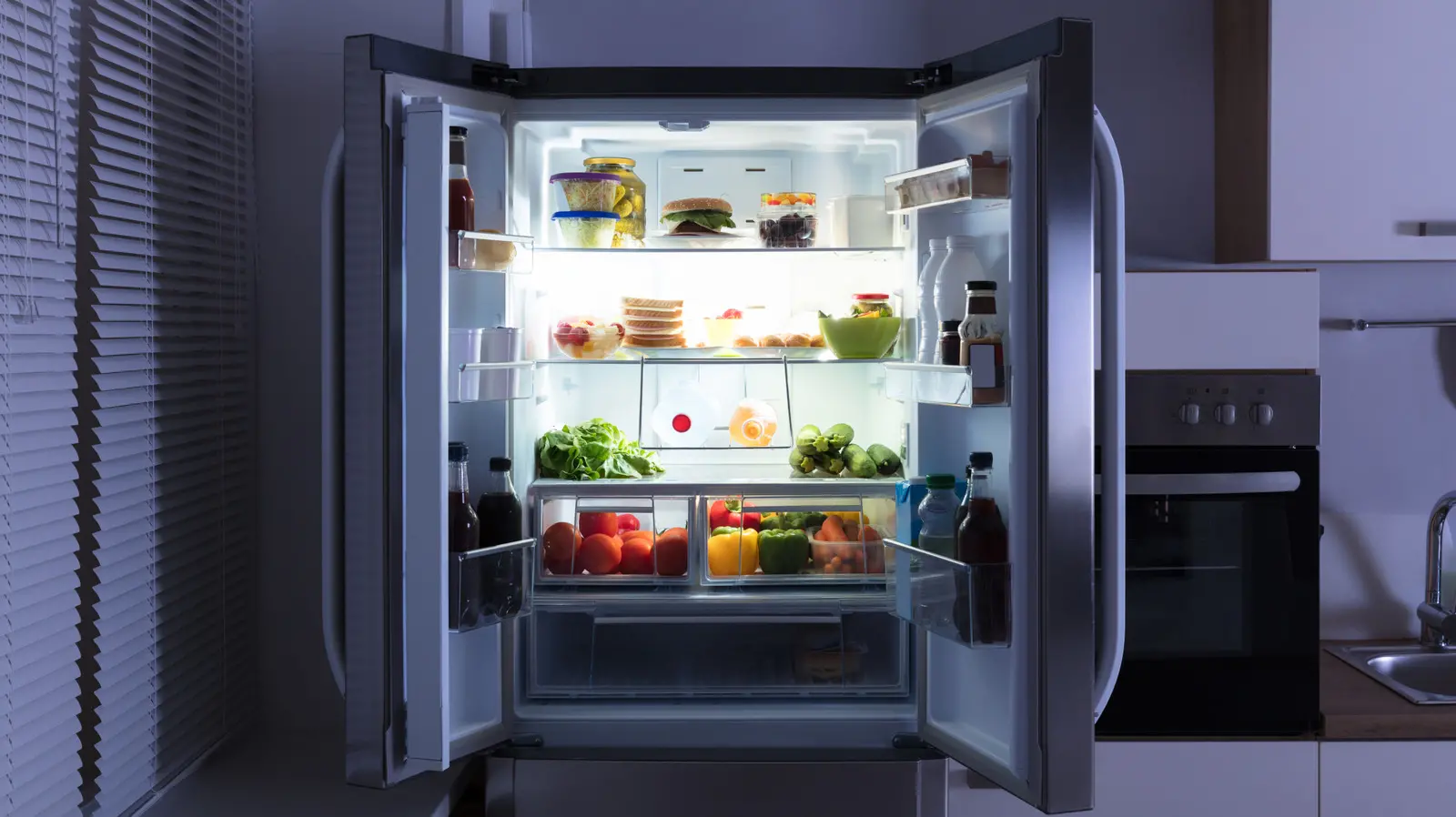
It's easy to make mistakes when buying and installing home appliances, especially refrigerators. You could either get a model that's too small to suit your needs, or you may end up with one that's way too big. Understanding the fridge's interior measurements can also be tricky, because "cubic feet" may as well be another language altogether for many buyers. The reason that measurement is used has to do with storage space.
Refrigerators are measured in cubic feet because it's actually the easiest way to understand how much room is available inside. Since you're essentially measuring a box and not a flat shape, you have to take volume into account, not just length. Cubic feet does this by combining the fridge's height, width, and depth into a single number. Doing it this way allows you to compare different brands from the worst to the best, since two units can look nearly identical, but have two very different amounts of usable storage.
The Mathematics Behind Cubic Feet
The calculation of cubic feet is straightforward: multiply the height, width, and depth of the interior space. Manufacturers provide these dimensions in the product specifications, but it's helpful to know how they arrive at the final number. For example, a refrigerator with interior dimensions of 24 inches (2 feet) wide, 30 inches (2.5 feet) deep, and 60 inches (5 feet) tall would have a capacity of 2 x 2.5 x 5 = 25 cubic feet. This is the standard way all refrigerator manufacturers report size, making it easy for consumers to compare across different models and brands.
It's important to note that cubic feet measured by manufacturers often include the freezer compartment as well. The total capacity is usually split between the fresh food section and the freezer. Some brands list separate capacities for each, while others provide a combined figure. When shopping, pay attention to whether the number represents total cubic feet or just the refrigerator portion. A 20-cubic-foot unit might offer 14 cubic feet of fridge space and 6 cubic feet of freezer space, or the reverse depending on design.
Why Cubic Feet Matters More Than Linear Dimensions
Many shoppers focus on the width and height of a refrigerator without considering depth. But depth can vary significantly, especially between standard-depth and counter-depth models. A counter-depth refrigerator may have the same width and height as a standard model but shallower depth, reducing its cubic footage by 20–30%. That's why relying solely on linear measurements can be misleading. Cubic feet accounts for all three dimensions, giving you a true sense of storage volume.
Moreover, interior layout and shelving can affect usable space. A fridge with 25 cubic feet might have bulky shelves, large door bins, or a center drawer that eats up capacity. Two models with identical cubic feet can hold different amounts of actual food. Therefore, while cubic feet is a useful starting point, it's not the only factor. Consider how you organize your groceries—tall bottles, wide platters, or bulk items—and look at interior photos to see if the shelving is adjustable.
Choosing the Right Size for Your Household
When it comes to the capacity you need, the best way to narrow it down is to the size of your household. For one to two people, a compact refrigerator in the 4 to 13 cubic foot range is usually enough. Couples or singles living in apartments or small homes often find that a 10–12 cubic foot model provides ample room for weekly groceries without taking up too much kitchen space.
If you have three to four people in your home, it's better to go with a mid-size model around 14 to 24 cubic feet. This range accommodates larger food purchases, leftovers, and a variety of beverages. Families with children often need extra freezer space for frozen meals, ice cream, and snacks. A 20-cubic-foot unit with a balanced fridge-to-freezer ratio works well for most families.
For households with five or more people, 25 cubic feet should be enough to handle the higher volume of food you'll need to hold. Large families may also want to consider side-by-side or French door designs that offer wider shelves and easy access. However, be mindful of kitchen space: a 30-cubic-foot refrigerator may require at least 36 inches of width and plenty of clearance for doors to swing open.
Measuring Your Kitchen Space Correctly
Before you fall in love with a model, you must ensure it fits your kitchen. Start by measuring the width of the upper cabinet over your current fridge, leaving at least 1 inch for clearance. You should also account for the countertop and base levels, using the narrowest point for the correct fit. Measure the height from the floor to the lowest point of the upper cabinet while checking the front and back of the space. Then measure the depth from the back wall to the front edge of the counters, leaving 2 inches free. Be sure you have enough room for the doors to open and leave about 1/8 inch on either side for proper clearance. Don't forget to double-check all your measurements.
Many people overlook the path the refrigerator must travel from the delivery truck to the kitchen. Measure doorways, hallways, and corners to ensure the appliance can be maneuvered into place. Some retailers offer in-home measurements as part of delivery service, but it's always safer to verify yourself. Also consider ventilation: refrigerators need airflow around the condenser coils. If you plan to install a counter-depth model flush with cabinets, check whether the manufacturer requires gap allowances at the top or back.
Organization Tips to Maximize Usable Space
If your current refrigerator still has some life left, but it's cramped inside, you can use clear containers to separate categories of food, making them easier to find. This will also allow you to get rid of bulky or oversized packaging. Labeling those containers with storage or expiration dates is a good idea, so you can stay on top of rotation while also making your available storage much more efficient.
Another effective strategy is to use vertical space. Stackable bins, hanging baskets, and door shelves can double the storage capacity. For example, use a lazy Susan for condiments or a shelf riser to create a second layer for small items. Keep frequently used items at eye level and designate specific zones: dairy in the upper shelves, raw meat in the bottom drawer, and fruits and vegetables in humidity-controlled crispers.
Freezer organization is equally important. Label and date all frozen items, and group them by category (e.g., vegetables, meats, prepared meals). Use bins or baskets to prevent items from getting lost in the back. A well-organized freezer not only saves space but also reduces food waste because you can see what you have at a glance.
Energy Efficiency and Size Considerations
Larger refrigerators generally consume more electricity than smaller ones, but the relationship is not linear. A 25-cubic-foot Energy Star model may use less power than an older 18-cubic-foot unit due to improved insulation and compressor technology. When choosing a size, balance your food storage needs with energy costs. If you often have empty shelves, you're wasting energy on cooling unused space. Conversely, a unit that is too small may force you to run multiple trips to the grocery store, which also has an environmental footprint.
Consider the layout of your kitchen in terms of heat sources. Placing a refrigerator next to an oven or dishwasher can cause it to work harder, increasing energy consumption. Leave adequate space around the appliance for air circulation, and vacuum the condenser coils periodically to maintain efficiency.
Finally, think about longevity. A well-chosen refrigerator can last 10–15 years. Investing in the right size now—one that accommodates your household's expected growth—can save you from needing to replace it sooner. If you plan to have children or host more guests in the future, opt for the larger end of your recommended range. If you live alone and rarely entertain, a compact model will suffice.
Understanding Different Refrigerator Types
Not all refrigerators with the same cubic feet offer the same usability. Top-mount freezers (freezer on top) are often the most space-efficient for their footprint because the freezer compartment is shorter but wider. Bottom-mount freezers (freezer on the bottom) give easier access to fresh foods but may have narrower drawers. Side-by-side models feature vertical doors that divide the fridge and freezer equally, making it easy to organize items but sometimes limiting width for large platters. French door models combine a bottom freezer drawer with two side doors above, offering wide shelves and good organization but often at a higher price point.
The shape of the interior matters. Some refrigerators have shelving that can be repositioned, while others have fixed bins. Adjustable shelves allow you to customize the layout for tall bottles or large containers. Door bins can hold milk jugs, soda cans, and condiments, but they reduce the width of the main shelves. When comparing models with the same cubic footage, examine the interior photos and dimensions of shelves to see which configuration matches your shopping habits.
Remember that the total cubic feet number includes both refrigerator and freezer compartments, but you may prefer a different split. Some models offer 70% fridge and 30% freezer, while others are closer to 50/50. Think about how much frozen food you typically store. If you buy in bulk or freeze meals, a larger freezer percentage might be valuable. If you eat mostly fresh produce, prioritize refrigerator space.
By understanding why cubic feet is the standard unit, learning how to interpret it, and considering your kitchen layout and household size, you can confidently select the right refrigerator. Take your time to measure, compare, and organize—your future self will thank you for the well-planned appliance that fits perfectly into your daily life.
Source:SlashGear News