

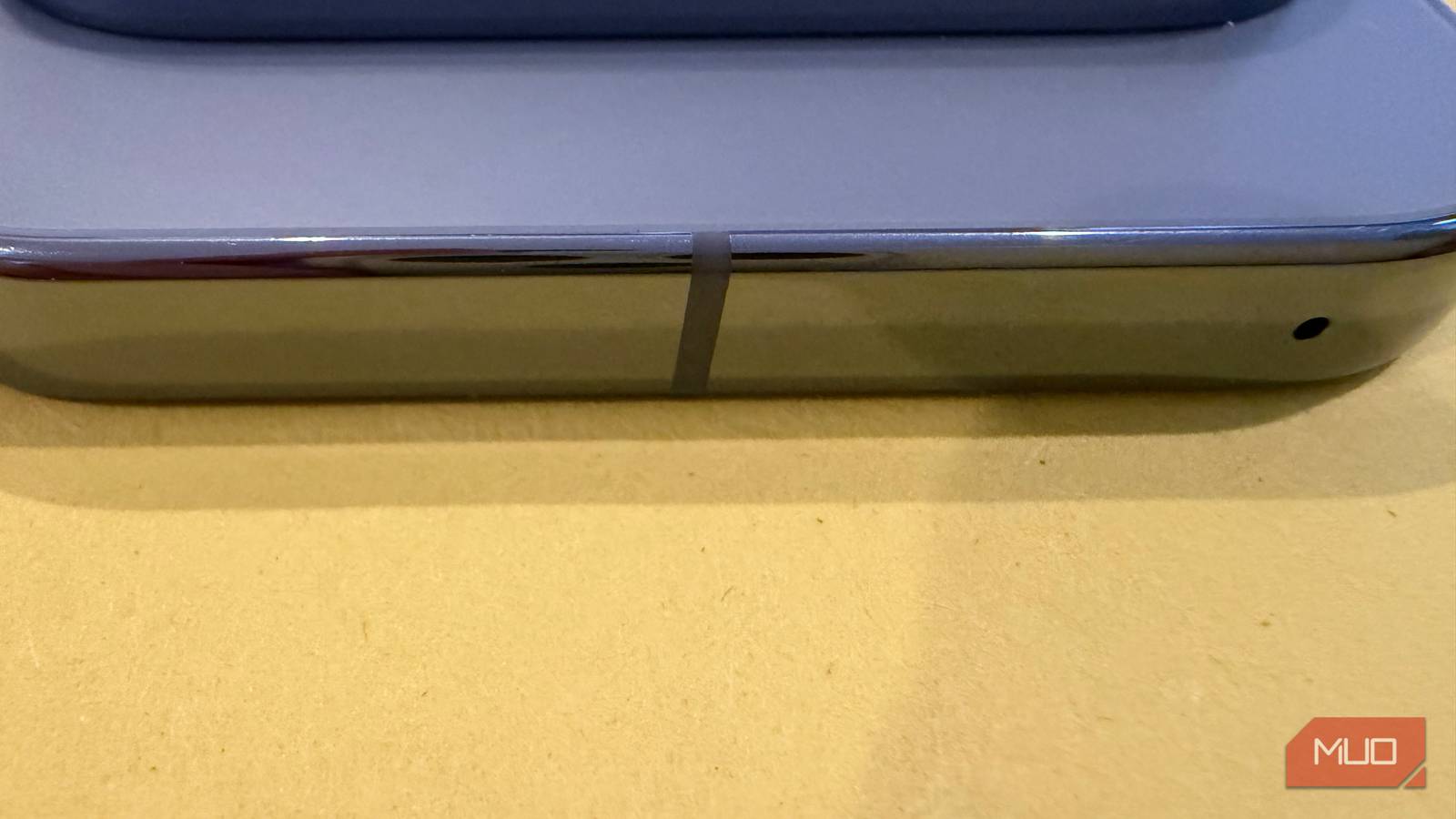
Have a look at your phone. Chances are, your phone has random lines integrated into the frame, perhaps on the side rails or along the back. You might even notice an oval-shaped cutout that looks similar to a fingerprint scanner, but it's not.
They aren't for looks — honestly, they're kind of ugly. They exist to solve an engineering problem every device maker has faced since phones moved to metal unibody construction.
What are these weird lines and cutouts on my phone?
They're not a design choice, they are a forced compromise
Older phones, such as the metal HTC One M7 from 2013 (when HTC used to make groundbreaking phones), awkwardly placed these lines on the back of the phone as a divider between various components of the phone. Later, manufacturers figured out how to place these lines along the edges of the phone, allowing the back to be a clean surface with no interruptions, as you can see with modern Samsung Galaxy phones and the iPhone Air.
The lines are actually antenna bands — thin strips of plastic or composite material that are inserted into the metal chassis. They act as windows for radio waves to pass through. The oval cutout on some phones is a dedicated mmWave 5G antenna window.
The problem: metal is the enemy
Metal blocks wireless signals
Before the widespread adoption of metal, most phones were made of plastic. Plastic was lightweight, durable, and critically did not interfere with the transmission of wireless signals. In the early 2010s, phone manufacturers made the move to metal unibody phones, often cut out of a solid block of aluminum.
This shift served multiple purposes. First, metal looked and felt premium. Metal has a timeless quality; it reflects light beautifully and feels cool to the touch. Metal phones from that era felt like precise jewelry — think of the shiny chamfered edges that graced a few flagship phones — compared to the cheap, greasy feel of plastic phones that picked up fingerprints and seemed low quality.
Second, metal improved heat dissipation. The enemy of most electronic devices, heat is especially problematic in compact phones that lack active cooling (such as the fans found in PCs) or advanced passive cooling materials like liquid metal. Metal bodies act as a giant heat sink because metals like aluminum are excellent thermal conductors. This helps prevent the processor from throttling, reduces battery drain, and prolongs component life.
Third, metal allowed for greater structural rigidity and tighter tolerances. As phones grew larger but thinner, plastic could not keep up with the demands for precise, premium, yet thin devices. Computer Numerical Control (CNC) machines can carve a phone from a single block of aerospace-grade aluminum, producing impossibly thin side rails while maintaining excellent strength.
However, these metal phones presented a critical engineering challenge: how could wireless signals — cellular, Bluetooth, Wi-Fi, GPS — escape what is essentially a Faraday cage? A metal enclosure that blocks electromagnetic fields is a death sentence for any wireless device.
The solution: plastic composite lines or glass windows
Manufacturers solved the problem by inserting thin strips of plastic or composite material into the metal frame. These strips act as radio-frequency (RF) windows, allowing signals to pass through. Another approach is to use glass cutouts, like the glass panel on the back of many iPhones or the "visor" found on Pixel devices. A secondary benefit of glass backs is that wireless charging becomes possible — fully metal phones cannot support inductive charging because the metal would block the magnetic field.
What about that new large oval on phones?
That's your mmWave 5G antenna cutout
On some devices, you might notice an oval cutout along the edge that looks like a fingerprint sensor. This is the mmWave 5G antenna window, designed for the ultra-rare flavor of 5G that was supposed to deliver gigabit speeds and ultra-low latency. However, mmWave networks are scarce — they only exist in certain densely populated areas and are expensive to deploy, have very short range, and drain battery rapidly. Consequently, your phone may never actually use this antenna. The standard antenna lines remain essential for low-band and mid-band 5G as well as 4G/LTE.
Those lines on your phone aren't for looks
They're a critical part of the wireless radio system
Now you know the true purpose of those lines. This is also why most modern devices have adopted the "glass sandwich" design: glass front and back with a metal frame. This approach allows wireless signals to pass through the glass while retaining the premium feel and structural benefits of metal where your hands touch the edges. Some manufacturers, like Samsung, even use glass that looks and feels exactly like metal, further blurring the line between form and function.
As phone materials continue to evolve — with introductions of ceramic, titanium, and recycled materials — the fundamental problem of signal interference remains. Every phone maker must carefully design antenna cutouts, whether as thin plastic lines, glass panels, or hidden under coatings. Next time you see those lines on your phone, remember that they are not imperfections but clever engineering solutions enabling reliable wireless communication.
Source:MakeUseOf News