

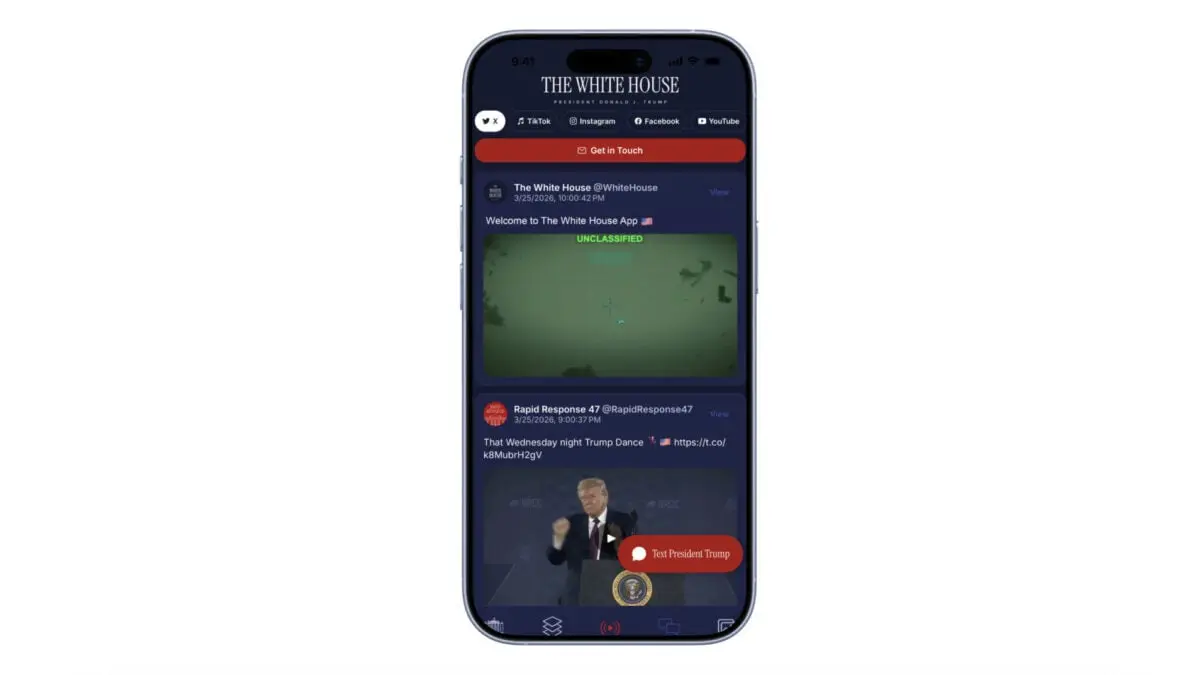
In a move that has sparked both curiosity and concern, the White House has reportedly instructed the Department of Homeland Security (DHS) to automatically install its official app on all mobile devices issued to DHS employees. The directive, first reported by Politico based on an internal email sent Tuesday, mandates that the app—known simply as the White House app—be loaded onto agency smartphones without an opt-in process. This means that any DHS staffer who hasn't already downloaded the app from the Apple App Store or Google Play will find it unexpectedly on their work phone, much like the controversial U2 album “Songs of Innocence” that was automatically added to millions of iPhones in 2014. However, the stakes are far higher here, as the app claims to deliver what the White House describes as “unfiltered, real-time updates straight from the source”—the source being President Donald Trump himself.
The app, which launched originally in March, was promoted as a convenient way for the public to access official White House communications, including breaking news alerts, executive actions, speeches, livestreams, videos, and other updates. According to the press release on the White House website, the first feature listed is “breaking news alerts on major announcements, executive actions, and other key priorities.” The app also includes a video streaming capability, a library of archived Trump sound bites, the ability to “stay connected” with new policies, and an option to send feedback, including by voice. The official illustration provided by the White House even shows a push notification with a dancing emoji and the phrase “That Wednesday night Trump dance🕺🇺🇸,” indicating the app's intended tone as a direct line to the President's persona.
However, the auto-installation order raises significant cybersecurity and privacy questions. According to a report from Notus.org, the app shares user data—including time zone, IP address, and more—with third parties, and “doesn’t disclose its data sharing the way most others do.” This lack of transparency has alarmed privacy advocates and former government IT officials alike. Sonny Hashmi, a former IT executive for the General Services Administration, told Government Executive that auto-installs of the app are “cause for alarm” because “any app that is installed on government issued devices can potentially create backdoor access to government networks behind the firewall.”
The Department of Homeland Security is not the first federal agency to receive this mandate. Last month, the Trump administration told all federal agencies to start installing the app on their phones, and at least one agency—the Federal Aviation Administration (FAA)—was already slated to receive the app as an auto-download. This suggests a broader push across the federal government to ensure that every employee with a government-issued mobile device has the President's messaging app at their fingertips. The implications for network security are profound, as each installation opens a potential vector for malware or unauthorized data exfiltration, especially if the app's code is not thoroughly vetted by agency security teams.
This is not the first time a White House has released an official app. In 2010, under President Barack Obama, an earlier version of the White House app was launched. That app, while not nearly as controversial, was also met with mixed reviews, largely because it existed during what some call the “there's an app for that” bubble of the early smartphone era. However, that earlier app was not forced onto government devices; it was a voluntary download for the public. The current administration's approach is markedly different in its scope and coercion, effectively turning every DHS phone into a distribution channel for presidential updates.
Critics argue that the auto-installation violates the principle of employee choice and could be seen as a form of political messaging on government time and equipment. DHS employees, who are tasked with protecting the nation's borders and cybersecurity, might find themselves in a situation where their primary work tool is being used to push content from a single political figure. While the app is described as a tool for official White House communications, the line between official government business and partisan messaging has often blurred during the Trump presidency. The app's push notifications could include executive orders, but also videos of the President dancing or making remarks at rallies, which some might consider campaign-style material.
Beyond the political concerns, the technical risks cannot be overstated. Every app installed on a government device requires permissions that may include access to the device's camera, microphone, contacts, location, and network connections. If the White House app shares these data points with third parties, as Notus.org suggests, it could create a pathway for sensitive DHS information to leak. Moreover, the automatic nature of the installation means that employees may not be aware of the app's presence or its data practices, making it difficult for them to take precautions. Government devices are supposed to be locked down with strict mobile device management policies, but automatic installs can circumvent normal vetting processes if not carefully managed.
Historical parallels exist in the private sector. In addition to the U2 album fiasco, major tech companies have faced backlash for automatically adding software without user consent. For example, Microsoft's Windows 10 forced update practices annoyed millions of users, and Facebook's attempts to pre-install apps on Android phones raised antitrust concerns. However, those were consumer products with relatively low security impact. In the context of DHS, which oversees everything from immigration enforcement to cybersecurity for critical infrastructure, the risk is exponentially greater. A vulnerability in the White House app could, in theory, be exploited by foreign adversaries to gain a foothold in government networks.
The White House has defended the app as a modern tool for transparency and direct communication. In a statement, a spokesperson emphasized that the app provides “unfiltered access to the President's message without media interpretation.” Supporters argue that it allows Trump to bypass traditional news outlets and speak directly to the American people—in this case, to the employees of one of the largest federal agencies. They also point out that the 2010 White House app existed without such controversy, and that the current app is simply a technological evolution.
Nevertheless, the legal and ethical boundaries of such mandates are unclear. The Hatch Act, which limits political activities by federal employees, could come into play if the app is used to disseminate campaign-related messaging. While the White House maintains that all content is official presidential communications, critics note that the line between official and political has often been blurred. For example, Trump's campaign rallies are frequently broadcast as official administration events, and his social media posts have mixed policy announcements with personal attacks. The app's notification system could be used to alert DHS employees to watch a speech that is primarily a campaign rally, potentially violating the spirit of the Hatch Act.
The incident also highlights a growing trend of governments using mobile applications to control the narrative. In other countries, similar apps have been used to disseminate propaganda or monitor citizens. While the US is not at that extreme, the forced installation on government employees sets a precedent that could be expanded under future administrations. If the app becomes standard on all government phones, future presidents—regardless of party—could use it to push their own messaging directly to millions of federal workers, effectively making them a captive audience.
From a technical perspective, cybersecurity experts recommend that any app installed on government devices be subject to rigorous security audits, penetration testing, and regular updates. The automatic distribution of the White House app should have been preceded by a thorough review by the DHS's own cybersecurity division, the Cybersecurity and Infrastructure Security Agency (CISA). Whether such a review occurred is unclear, but the speed of the rollout suggests that it may not have been as thorough as necessary. The email received by DHS employees on Tuesday likely provided little more than a link to the app's description and a note that it would be installed automatically. Employees were not given an option to refuse, and no instructions for disabling or removing the app were provided.
In response to concerns, several privacy-focused organizations have indicated they may file complaints with the Office of Government Ethics or even consider litigation if the app is found to violate privacy laws. The American Civil Liberties Union (ACLU) has previously raised alarms about government overreach in digital spaces, and this case could become a new front in that battle. For now, DHS employees and other federal workers are left with a new app icon on their phones, representing a direct line to the President—a line that some argue should not be forced onto them.
The broader implication for federal employees is that their work devices are increasingly being used for political communication, which raises questions about the use of taxpayer-funded resources for partisan purposes. While the White House insists the app serves official functions, the inclusion of features like video streaming of speeches and a library of sound bites suggests a marketing and public relations tool as much as a government service. As the Trump administration continues to push the boundaries of how technology and politics intersect, this move is likely just one of many steps in a larger strategy to digitize the presidency and control the flow of information directly to the workforce.
Source:Gizmodo News