

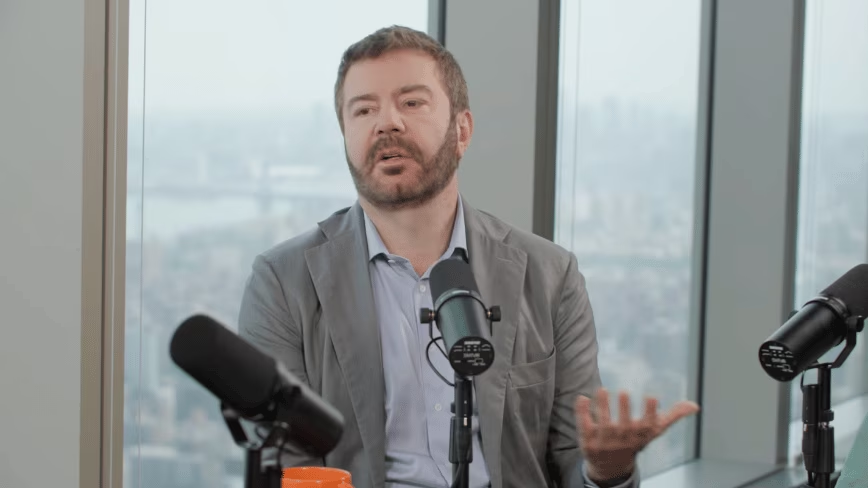
Few people have done more to automate the office than Daniel Dines. As the founder and former CEO of UiPath, he built one of Europe's most successful software companies by selling robotic process automation (RPA) tools that handle repetitive white-collar tasks. Yet in a recent episode of his company's podcast, The Path Forward, Dines delivered a surprising message to executives: don't rush to cut staff in the name of AI.
Dines sat down with UiPath colleague Andrada Morar to discuss the intersection of artificial intelligence and employment. His tone was measured, even cautious. “Everybody feels some sort of anxiety, me included,” he said. “We don’t know how our kids’ career is gonna look like.” This admission from a man who has spent two decades pushing automation into the enterprise is striking. His antidote to that unease is a line he repeats often: in times of anxiety, action is the answer.
No Einstein in the data centre
Dines is impatient with the grand promises circulating in the AI industry. Some executives talk about deploying “50 million Einsteins in the data centre.” He thinks that is only half right. A large language model, he argues, is an average of everything it has ingested. “An average by definition doesn’t have a taste,” he said. He tested this himself by asking models to write fiction in a specific authorial style. The results came back bland and uninspired.
Taste, Dines believes, comes from lived experience, not from memory. He reaches for an analogy: skiing. You can memorise every book ever written about the sport. It will not make you a skier. You have to fall on the slope. That gap matters inside a company. Every enterprise runs the same handful of frontier models — GPT-4, Claude, Gemini — with the same weights. Feeding them proprietary data does not make them grasp your unique customer base or your internal processes. “Our memory is not our identity,” he said.
Two ledgers, not one
His warning to executives is blunt. Do not read a job as a single output. Consider a lawyer who reviews contracts. The visible outcome is a signed deal, and AI can speed that up significantly. But the hidden outcomes are harder to quantify. That same lawyer might mentor junior associates, hold a fragile client relationship together, or carry years of unwritten institutional knowledge about negotiation tactics and risk tolerance.
Dines wants firms to keep two ledgers: one for visible outcomes and one for hidden ones. Cut blindly, he says, and you destroy value you never measured. This is a pointed message from a man who sells automation. It lands against a backdrop of real cuts. Carmakers have shed more than 20,000 white-collar jobs in recent quarters, and a growing chorus of bosses now pitch AI as a way to do more with fewer people. That is a sharp reversal from two years ago, when the dominant narrative was that AI would augment rather than replace workers.
He also thinks the shift is slower than the hype suggests. AI agents cannot simply plug into messy, legacy business processes. Most firms have never mapped out who is allowed to approve an invoice, or who has the authority to pay one. That knowledge sits in people’s heads and across departmental silos. Documenting it will take years, he says, not a weekend.
The identity problem
The deepest worry in the conversation is not about tasks. It is about identity. Dines traces his interest in the subject to a lawyer friend. She told him her fear was not that her job would vanish. It was that her identity would become irrelevant. Many people build a sense of self around their profession. He calls protecting that a shared human interest, and frames the human cost as the thing enterprises risk losing.
He is unconvinced AI will grow a self of its own. To him it is a tool, closer to electricity than to a colleague. He borrows an idea from an American philosopher of the 1970s, an argument that echoes Harry Frankfurt. There are two orders of will. A model can want something — generate text, solve a problem — but only a person can want to want something, can want to become better. Chasing a machine that truly reasons, he adds, would mean finding a way to inject pain and risk building a Frankenstein no one understands.
Curiosity over credentials
Morar picked up the human thread. Models have memory, she said, but they lack the motivation to be excellent. AI can hand you knowledge. It cannot hand you curiosity, or the grit to push through when something breaks. She looks for those traits in her own team and argues that companies must continue to hire and mentor junior staff. Skip that, and there will be no senior leaders in a few years.
There is a customer angle too. So much support has moved to bots that people now jab at their phones asking for a human. That friction, Morar suggests, is a clue about what only people offer: genuine empathy, adaptation, and the ability to handle novel situations.
None of this is disinterested. UiPath sells the agents and robots that make the cuts possible. A message that transformation is long, careful, and human-heavy also happens to describe a long, expensive engagement for clients. Even so, coming from an automation billionaire, the caution is worth hearing.
Governments are already counting the jobs AI touches. Dines’s bet is that the roles left standing will be richer, not poorer. The anxiety, his own included, is the price of not yet knowing. Meanwhile, his advice to business leaders remains consistent: act, but act with patience. Measure both ledgers. And never forget that a company’s true asset is not its technology, but the people who bring unwritten knowledge, taste, and identity to work every day.