

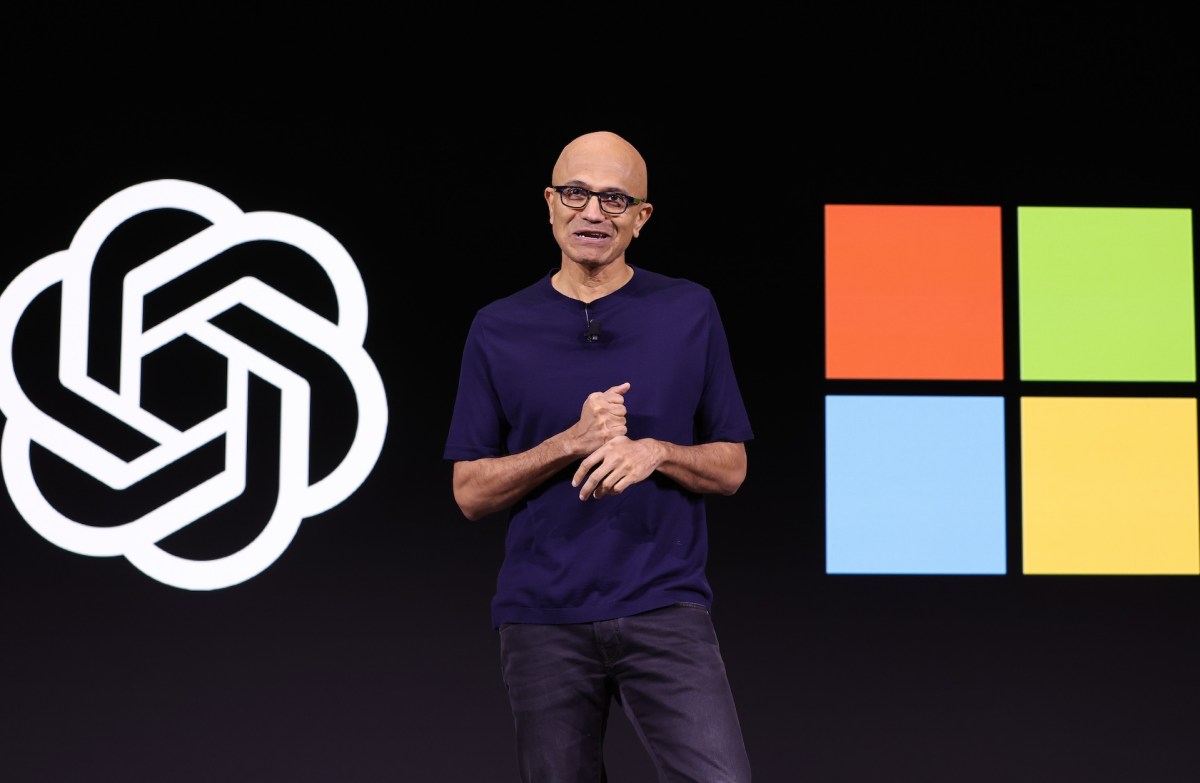
Of all the debates raging about the potential downsides of artificial intelligence, one concern is causing the deepest worry among AI enthusiasts in Silicon Valley. The fear is that the large AI labs selling proprietary models are acting like Trojan horses, gaining unprecedented access to the most sensitive business information of the companies that use them. And now, in a surprising blog post published on Sunday, Microsoft CEO Satya Nadella has openly joined this warning chorus.
Nadella’s argument is stark: enterprises that use models from labs such as OpenAI or Anthropic are paying twice. They pay directly for token usage, but they also pay indirectly—and often unknowingly—by handing over their proprietary data. “You essentially pay for intelligence twice, once with money, and again with something even more valuable: the proprietary knowledge you must reveal to make that intelligence useful,” he wrote. “The better you want the model to perform, the more of that knowledge you have to feed it!”
The Data Exhaust Problem
Nadella points out that models learn from “exhaust”—the prompts people write, the tools agents use, and especially the corrections users make when the model is wrong. Every correction is distilled into institutional know-how, the kind of knowledge a competitor could never buy. Yet enterprises are handing it over freely. This concern is not new; investors like Jason Calacanis and Palantir CEO Alex Karp have previously warned that the data given to AI models could be used against the very companies providing it.
The danger is compounded when model makers reserve the right to learn from customer usage and interaction data. In such arrangements, the labs become more than vendors—they become silent observers of the intimate workings of their customers’ businesses. Over time, they could use that knowledge to develop competing products or services, or to train future models that give an advantage to other clients.
Nadella’s Proposed Solution
Nadella’s solution is rooted in the idea of data sovereignty. He wants companies to “retain ownership” of their data, including prompts, feedback, and corrections. To do this, he urges enterprises to build their own “proprietary learning environments” on the cloud—likely meaning Microsoft’s Azure, though he does not explicitly mention it. He also advocates for building “orchestration layers” that allow companies to easily switch between AI models from different providers, rather than being locked into one. Tools like AI “gateways” that enable this switching have become increasingly popular.
While Nadella never uses the words “open source,” the subtext is clear: enterprises should consider using open source models that they can control and deploy on their own infrastructure. This is exactly what many large companies are already doing. Idit Levine, founder and CEO of Solo.io, which makes networking and security software for managing AI systems, says her customers are shifting from proprietary models to open source ones running on their own premises. “Can I take an open source model and run it on-prem? It will do almost 90% of what the big one’s doing. It will cost way less,” she told TechCrunch. “They understand that, and they can control it.”
The Rise of Open Source Models
Solo.io’s technology was selected last year to power the Linux Foundation’s Agentgateway project, and its enterprise customers include T-Mobile, ADP, and SAP. Levine sees the on-premise open source model wave as the next big trend in enterprise AI use. Her view is supported by data from other companies. Vercel, best known for building and hosting websites but now offering AI model-switching tools, and OpenRouter, a company that helps developers route requests across different AI models, both report a surge in traffic to open source models. Last month, open models accounted for 29% of all traffic routed through Vercel’s gateway.
The shift toward open source is not just about cost savings. It also addresses the deep concern about data leakages and competitive intelligence. When a model runs on a company’s own servers, the data never leaves its control. No third party can learn from the interactions or corrections. This is especially important for industries like finance, healthcare, and defense, where data privacy regulations are stringent and the cost of a breach is enormous.
The Distillation Debate
Nadella also tackles the contentious issue of distillation—the practice of using a model’s own outputs to train a new, often cheaper, model. In February, Anthropic accused Chinese open source models of sending millions of prompts to Claude as a way to improve their own models, urging the U.S. government to crack down on export controls. Nadella argues that model makers cannot have it both ways: it is hypocritical for them to freely train on the world’s data while imposing restrictive terms on distillation. “While the great innovation that comes from model providers having fair use rights to train models on public data is needed, I find it ironic that the status quo is to then turn around and impose restrictive terms on distillation,” he writes.
This puts Microsoft in an interesting position. The company has invested billions in both OpenAI and Anthropic, yet its CEO is now openly warning enterprises to be wary of using those very models. Some observers see this as a strategic move to steer customers toward Microsoft’s own cloud and AI services, which can be deployed in a more controlled manner. Others view it as a genuine recognition of the risks that come with centralized AI labs holding vast amounts of corporate secrets.
Historical Context and Industry Reactions
The fear of vendor lock-in is not new to the enterprise technology world. For decades, companies have worried about becoming too dependent on a single software provider. But AI introduces a new dimension: the vendor not only provides the tool but also learns from the customer’s most sensitive data. This is reminiscent of the early days of cloud computing, when companies hesitated to move critical workloads to the cloud because they feared losing control of their data. Eventually, cloud providers offered better security and compliance guarantees, and the concerns subsided. But with AI, the data itself is the input that makes the models smarter, so the issue is more acute.
Nadella’s blog post has already sparked debate among AI experts and enterprise leaders. Some argue that he is overstating the risk, pointing out that many model makers have strict data usage policies and contractual protections. Others say that contracts are only as good as the enforcement mechanisms, and that the real danger lies in the long-term accumulation of knowledge by model makers. If a lab like OpenAI or Anthropic amasses enough institutional knowledge about a particular industry, it could eventually create a competing product that undercuts its customers.
The open source community, meanwhile, sees Nadella’s endorsement as a validation of their approach. Open source models like LLaMA, Mistral, and Falcon are freely available for download, and they can be fine-tuned on private data without any data leaving the organization. Companies like Meta have even released their models under permissive licenses to encourage adoption. The trade-off is that open source models often require more technical expertise to deploy and maintain, and they may not achieve the same performance as the largest proprietary models. However, as Solo.io’s Levine noted, for many enterprise use cases, an on-premise open source model can deliver 90% of the value at a fraction of the cost.
What This Means for the Future
Nadella’s warning is likely to accelerate the trend toward hybrid AI architectures, where companies use a mix of proprietary and open source models depending on the sensitivity of the task. For simple queries or public-facing applications, a proprietary model might be fine. But for core business processes, where the data is proprietary and the stakes are high, enterprises will increasingly turn to models they can control. This could lead to a fragmentation of the AI market, with a few giant labs serving low-stakes consumer applications and a long tail of specialized, self-hosted models serving enterprise needs.
Nadella’s final point—that “in consuming intelligence, you are creating intelligence. And what you create should belong to you”—captures the essence of the debate. As AI becomes more embedded in business operations, the question of who owns the insights generated from those operations will become critical. The companies that solve this ownership problem—whether through open source, cloud orchestration, or new contractual arrangements—will be the ones that reap the full benefits of AI without giving away their competitive edge.
Source:TechCrunch News