

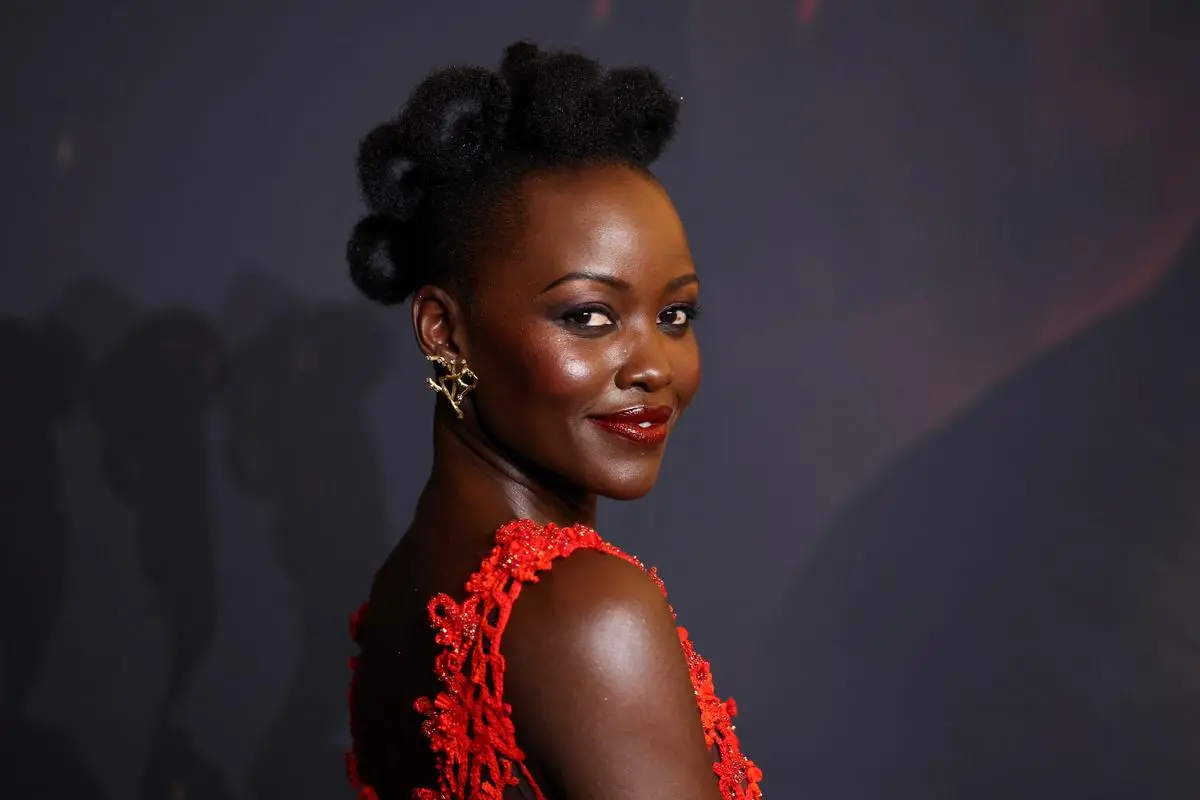
In July 2026, the release of Christopher Nolan's long-anticipated adaptation of Homer's epic poem 'The Odyssey' brought with it a wave of cinematic excitement, but also a storm of controversy. At the center of this storm is Lupita Nyong'o, a celebrated actress who has been cast as Helen of Troy, arguably one of the most iconic female figures in Western classical literature. Almost immediately, the far-right 'fachosphere', led by figures such as Elon Musk, erupted in outrage, decrying the casting as historically inaccurate. But who exactly is Lupita Nyong'o, and why has her casting ignited such a fierce debate?
Who is Lupita Nyong'o?
Lupita Amondi Nyong'o was born on March 1, 1983, in Mexico City, Mexico, to Kenyan parents. Her father, Peter Anyang' Nyong'o, is a prominent Kenyan politician and scholar, while her mother, Dorothy Nyong'o, runs a communications consultancy. The family moved back to Kenya when Lupita was a toddler, and she grew up in Nairobi. She attended prestigious schools in Kenya and later studied at Hampshire College in the United States, where she earned a degree in film and theater studies. She then went on to earn a master's degree in acting from the Yale School of Drama in 2012.
Nyong'o's breakthrough came almost immediately after graduating from Yale. In 2013, she was cast as Patsey in Steve McQueen's harrowing historical drama '12 Years a Slave'. Her performance was nothing short of extraordinary, earning her widespread critical acclaim and a host of awards, including the Academy Award for Best Supporting Actress. She became the first Kenyan and Mexican actress to win an Oscar, and her emotional acceptance speech resonated globally. Since then, she has taken on diverse roles in both blockbuster and independent films. She played Nakia in Marvel's 'Black Panther' (2018) and its sequel 'Black Panther: Wakanda Forever' (2022), Maz Kanata in the 'Star Wars' sequel trilogy, and a starring role in Jordan Peele's horror film 'Us' (2019). She also voiced characters in 'The Lion King' (2019) and lent her talents to numerous other projects both in front of and behind the camera.
Beyond acting, Nyong'o is also a published author, with a children's book titled 'Sulwe' (2019) that explores themes of colorism and self-acceptance. She is a vocal advocate for women's rights, racial equality, and representation in the entertainment industry. Her career is a testament to her versatility and depth as an artist, and she is widely respected as one of the most talented actresses of her generation.
The Casting in 'The Odyssey'
Christopher Nolan's 'The Odyssey' is an ambitious film that aims to bring Homer's epic to life with a star-studded cast. The story, set during the Trojan War, follows the hero Odysseus on his ten-year journey home after the fall of Troy. Within that narrative, Helen—the wife of King Menelaus of Sparta—plays a pivotal role as the woman whose abduction (or elopement) with Paris of Troy sparks the entire war. She is described in Homer's text as 'the face that launched a thousand ships,' a symbol of beauty so powerful that it could cause a decade-long conflict.
When it was announced that Lupita Nyong'o would portray Helen, many fans were thrilled by the choice, seeing it as a bold and inclusive casting decision. Nyong'o's talent and presence seemed ideal for a character that requires both gravitas and vulnerability. However, the far-right segment of the internet, often referred to as the 'fachosphere' (a portmanteau of 'fascist' and 'sphere'), quickly seized upon the announcement as an example of what they see as forced diversity in Hollywood. Leading the charge was Elon Musk, the billionaire entrepreneur and owner of X (formerly Twitter), who posted a series of remarks questioning the historical accuracy of a Black actress playing a figure from Greek mythology.
The Backlash from the Fachosphère
The backlash was immediate and virulent. Musk, who has amassed a massive following on X, tweeted that 'Greek mythology is based on the ancient Greeks, who were white. This is not accuracy, it's ideological propaganda.' His tweet was echoed by numerous accounts on the platform, many of which used the hashtag NotMyHelen to amplify their displeasure. Articles from far-right outlets described the casting as a 'woke' decision that disrespects European heritage. Some users even created memes and manipulated images to mock Nyong'o's appearance.
However, this controversy is not new. Similar backlash occurred when Noma Dumezweni was cast as Hermione in the stage play 'Harry Potter and the Cursed Child' in 2016, or when Halle Bailey was chosen to play Ariel in Disney's live-action 'The Little Mermaid' in 2023. Each time, the far-right fachosphere argues that race-blind casting destroys the integrity of the original work. Yet, in the case of ancient Greek mythology, the historical grounds for such attacks are highly questionable.
Scholars have pointed out that the ancient Greeks themselves had contact with many different peoples across the Mediterranean and Africa. The very concept of 'whiteness' as a racial category did not exist in the same way it does today. Homer's epics are works of fiction that incorporate elements from various cultures. Moreover, depictions of Helen in ancient art varied, and there is no concrete evidence to suggest she was of a specific skin color. The far-right's insistence on a particular appearance is based on modern racial ideologies rather than historical fact.
Cultural and Historical Context
The idea of a Black actress playing Helen of Troy is not as anachronistic as it might first appear. The Mediterranean world of the Bronze Age was a melting pot of peoples. The Minoan civilization, which preceded the Mycenaean Greek culture, had connections with Egypt and other African civilizations. There is even scholarly speculation that some figures in Greek mythology may have had African origins, as seen in the myth of Andromeda, who was the daughter of the Ethiopian king Cepheus. Furthermore, classical Greek vase paintings sometimes depicted figures with dark skin, especially in scenes involving Ethiopians (who the Greeks called 'Aithiopians'). While Helen is traditionally described as having fair skin and golden hair, these descriptions are literary devices more than objective records.
Moreover, the controversy ignores the long tradition of creative interpretation in the arts. Shakespeare's plays have been staged with diverse casts for decades. Modern retellings of Greek myths, such as Madeline Miller's novel 'The Song of Achilles' or Pat Barker's 'The Silence of the Girls', have reimagined characters in ways that resonate with contemporary audiences. Nolan's adaptation is just the latest in a long line of interpretations that prioritize artistic vision over rigid adherence to outdated descriptions.
Nyong'o's Response and Support
Lupita Nyong'o has largely remained dignified and silent on the controversy, letting her work speak for itself. However, in a recent interview, she addressed the criticism with grace, stating: 'I'm honored to bring a new dimension to Helen, a character who has been interpreted many times over the centuries. What matters is the emotion and truth of the story, not the color of my skin.' Her words reflect the view that acting is about embodying a character's essence, not simply matching physical attributes.
Many in the film industry and the public have rallied to her defense. Actors like Viola Davis and Idris Elba voiced support, as did numerous film critics who praised the casting as a step forward for inclusivity. Christopher Nolan himself issued a brief statement emphasizing that his film is a work of fiction and that cast choices are made based on performance ability, not racial politics. The Academy of Motion Picture Arts and Sciences also expressed solidarity with Nyong'o, highlighting the importance of diverse representation in storytelling.
Meanwhile, mainstream media outlets and social media users have pointed out the irony of Elon Musk's involvement, given that he has previously advocated for free speech while simultaneously engaging in what many see as targeted harassment. The same X platform that Musk claims to protect has been flooded with racist messages that violate its own policies. The controversy underscores the ongoing culture war in which casting decisions become flashpoints for broader societal debates about race, identity, and historical interpretation.
In the end, the backlash against Lupita Nyong'o's casting as Helen of Troy says more about the state of modern discourse than it does about the accuracy of the film. As 'The Odyssey' continues its run in theaters, audiences are likely to judge the film on its own merits—its storytelling, visual effects, and performances. And by all accounts, Nyong'o's portrayal is captivating, proving once again that great acting transcends the boundaries of race and mythology.
Source:Le Nouvel Obs News