

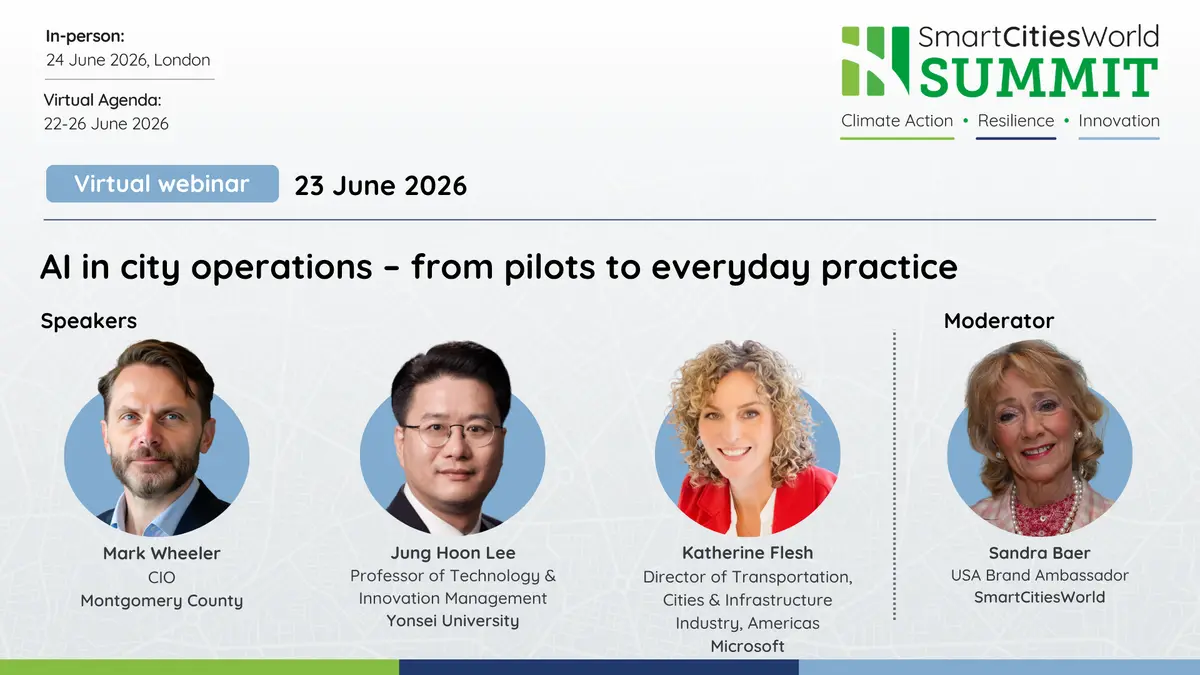
The era of isolated artificial intelligence experiments in city management is giving way to a more integrated and mature approach. Yet the journey from proof-of-concept to everyday municipal operations remains fraught with technical, organizational, and governance challenges. A highly anticipated virtual panel discussion, scheduled as part of a major urban technology summit in 2026, is set to confront these challenges head on, offering city leaders a strategic roadmap for embedding AI into the fabric of public services.
The conversation will centre on how local authorities can strengthen workforce decision-making by bringing together three essential pillars: unified datasets, secure digital foundations, and a new generation of autonomous—or “agentic”—AI solutions. Rather than treating AI as a disconnected tool, cities are now expected to weave it into existing workflows, shifting from a pilot-driven culture to one of continuous, operational improvement.
The limits of pilot projects
For more than a decade, municipal governments have launched hundreds of AI pilots—from traffic prediction systems to intelligent streetlighting and automated service chatbots. While many delivered promising results, few have scaled convincingly. The reasons vary: fragmented data silos, weak digital infrastructure, safety and ethical concerns, and a chronic lack of investment in employee training.
The panel aims to shift the lens from technical experimentation toward a more strategic, risk-based approach to infrastructure resilience. That means understanding AI not as a novelty but as part of core urban systems, where failure can carry serious consequences. In this context, cities must prioritize cybersecurity, interoperable platforms, and human oversight before they can deploy AI widely.
Lessons from smart city exemplars
Real-world examples are already emerging. Sunderland, a former industrial city in the north of England, has repositioned itself as a leading smart city through long-term connectivity investment, civic leadership, and trusted partnerships. Recent research indicates that the city’s smart city programme is generating measurable economic, social, and public-service benefits. Its trajectory provides a notable case of how digital ambition can be turned into tangible impact when local government commits to a multi-year strategy rather than a patchwork of short-term experiments.
On a different scale, Singapore continues to reinforce its reputation as one of the smartest nations on earth. The island city-state has advanced an AI-ready infrastructure, embedding sensors and data-sharing platforms across transport, housing, and public utilities. By coupling national-level digital identity with AI-enabled services, Singapore demonstrates how the convergence of data, technology, and governance can support a responsive and resilient city.
The strategic role of unified data and 'agentic AI'
One of the recurring themes of the event is the development of “agentic AI”—systems that do not simply provide predictions or recommendations but can take autonomous actions within defined boundaries. In city operations, this may allow for real-time adjustment of traffic signals, dynamic allocation of waste collection resources, or automated responses to utilities outages. Agentic AI, however, requires a radical upgrade of data architecture. Dispersed, inconsistent data across departments undermines both the performance and trustworthiness of such systems.
Panelists are expected to argue that unified data strategies are foundational. That means building shared data lakes, adopting open standards, and ensuring data quality and provenance. Without a single source of truth, AI models will continue to produce insights that are difficult to act upon—or, worse, are inconsistent with the realities on the ground.
Addressing the 'AI super gap'
Professor Jung Hoon Lee, a prominent academic adviser on urban technology, will join the discussion to highlight a troubling trend he calls the “AI super gap.” Recent research into global smart city indices reveals that a small number of leading cities are accelerating ahead, while a much larger group lags behind. The divide is not simply a matter of budgets; it reflects the capacity to build data platforms, cultivate AI-ready infrastructure, and exercise effective governance.
The next phase of urban innovation, Professor Lee argues, depends as much on institutional readiness as on technology. Cities that succeed in closing the gap are those that have established clear ownership of AI projects, set standards for ethics and transparency, and invested in civil servant training. Without those foundations, the promise of AI will only deepen inequality between the world's best-served citizens and those already marginalized.
Cybersecurity as the bedrock of intelligent infrastructure
No discussion of AI in city operations would be complete without addressing cybersecurity. Fabio Mauri, an authority on technology operations and security at a leading smart infrastructure firm, stresses that the convergence of physical and digital systems creates new vulnerabilities. Illumination networks, traffic control, and power management systems are increasingly connected—and therefore exposed to malicious actors. He calls for security-by-design approaches, especially in commonly deployed solutions like smart street lighting, which often serve as gateways to wider municipal networks.
The threat landscape has grown so quickly that traditional, perimeter-based security is no longer sufficient. City governments must adopt continuous monitoring, zero-trust architectures, and a security culture that extends across suppliers and contractors. This is especially important as AI systems begin to control physical devices and autonomous processes.
Governing AI with workforce readiness
Transport agencies are a case in point. Many have turned to AI to improve reliability, reduce congestion, and optimize public transport networks. But as Katherine Flesh, an industry leader in transportation technology at Microsoft, points out, the greatest opportunities will depend on strong data foundations, workforce readiness, and responsible governance. Algorithms cannot overcome bad data—nor can they substitute for skilled staff who understand the context and limitations of AI tools.
Participants are expected to recognize that public officials need new skills: interpreting model output, managing exceptions, and explaining decisions to citizens. The workforce challenge is not simply about data scientists but about upskilling everyone from field technicians to city managers. Effective AI governance, they argue, relies on human accountability and clear lines of authority.
Toward a resilient and inclusive smart city
The conversation also points to a broader vision of resilience. Rather than aiming for isolated, flagship installations, cities are moving toward integrated systems that can withstand shocks—be they cyber-attacks, natural disasters, or public health emergencies. In this view, AI is the engine for analysis, prediction, and adaptation, but the entire vehicle must be built on trusted digital foundations.
During the virtual event, a key segment will explore how cities like Cayala, one of Central America’s largest private city projects, are using agile transformation and community-led services to scale infrastructure. The CTO of Cayala, Juan Carlos Lopez, will share insights on how digital infrastructure and value-management frameworks enable a rapidly expanding urban environment. The case emphasizes that even in privately developed cities, public value creation must be deliberate.
The impact of these efforts will be evaluated not only by efficiency but also by environmental sustainability and social equity. The speakers will consider how cities can use AI to better anticipate the needs of vulnerable populations, reduce carbon emissions, and improve access to services.
As the webinar unfolds, attendees will gain understanding of the concrete steps needed to transition from pilots to everyday practice. Clear signals from the speakers are that investment in people, data stewardship, and security will separate those cities that benefit from AI from those that merely experiment with it. The future of urban intelligence belongs to local authorities willing to make that holistic commitment.
Source:Smart Cities World News