

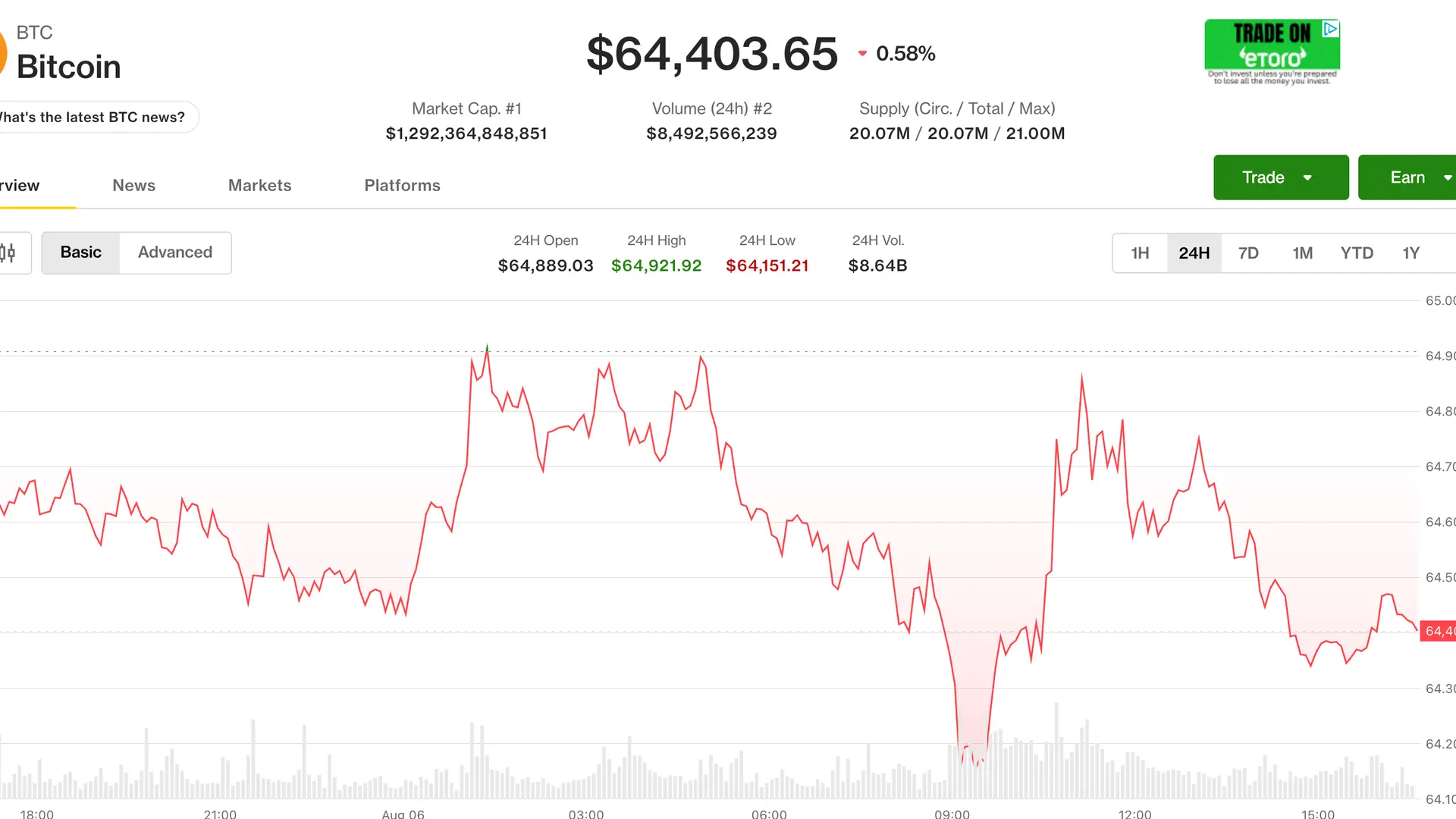
Bitcoin spent Thursday flatlining near $64,000, with the cryptocurrency stuck inside an extremely tight trading range as investors braced for Friday's July jobs report. The market's attention was split between macro data, corporate earnings, and geopolitical headlines, yet none were enough to push bitcoin out of its narrow band. At its most recent check, bitcoin was trading around $64,500, essentially unchanged over the prior 24 hours, according to data from major exchanges. Ether showed a slightly stronger bid, rising about 2% on the day, but most other major cryptocurrencies barely moved. The mood across crypto was one of caution and selectivity rather than broad risk appetite.
Friday's nonfarm payrolls report is widely seen as the key catalyst that could break the current consolidation. The June report was a weakish one, with only 57,000 jobs added, and another soft print could quickly lead investors to pare back expectations of a Federal Reserve rate hike in September. In contrast, a strong report would likely cement expectations of tighter central bank policy into the end of the year. Economists surveyed expect 80,000 new jobs in July, an uptick from June but still historically modest. The unemployment rate is expected to hold steady at 4.2%. Adding to the picture, Thursday's initial jobless claims came in at 199,000, slightly below the 202,000 forecast, while the four-week average dipped to 198,750. Claims around 200,000 or lower are typically associated with a very strong labor market, which further complicates the outlook for the Fed.
Markets are at an important point, with investors trying to work out whether inflation will keep slowing or stay stubbornly high, according to Oxford Economics. The research firm said this week's economic data, especially the jobs report, could influence expectations for interest rates and what the Federal Reserve does next. Bond yields continue to be relatively high due to U.S. government borrowing, keeping long-term borrowing costs elevated even as markets expect fewer rate increases than they did a few weeks ago. Investors are also listening closely to comments from Fed officials for clues about how committed they are to bringing inflation back to target. The two-year Treasury note yield rose six basis points on Thursday to 4.24%, partly reflecting a surge in oil prices.
Fed Chair Kevin Warsh reportedly stood ready to raise interest rates in September if inflation fails to ease over the coming weeks, according to a Financial Times report. The story said Warsh was prepared to hike if inflation readings do not cooperate and bond markets continue to come under pressure. People close to Warsh acknowledged he had made mistakes in his first 10 weeks at the helm of the world's most important central bank, including failing to reinforce his key messages on price stability and sowing confusion over his longer-term reform plans. Warsh has made clear he is not a fan of the Fed's habit of guiding markets through winks, nods, and opaque language, though the report suggested that approach has not fully taken hold. On a longer-term perspective, many economists expect inflation to continue easing as services price increases slow, tariff effects fade, and supply chains improve. If that happens, the Fed may leave interest rates unchanged for an extended period, creating a more stable environment for stocks, bonds, and the broader economy, even if markets remain choppy in the short term.
Cryptocurrency mining stocks dominated the earnings calendar on Thursday, with mixed results. MARA Holdings posted a second-quarter net loss of $611 million, missing earnings estimates as large unrealized losses on its bitcoin holdings overshadowed modest growth in mining output. Revenue came in at $174.9 million, below the $204 million consensus estimate. The company mined 2,422 BTC during the quarter, up 3% from a year ago, and increased its energized hashrate 22% to 70.3 EH/s. However, bitcoin held fell 29% from year-ago levels to 35,577 BTC. Shares traded flat near $10.60 following the report, after slipping 5% during the regular session ahead of earnings.
CleanSpark also reported quarterly results that missed Wall Street revenue expectations, posting $138 million in revenue versus the Street's $149 million estimate. Shares fell about 0.5% in after-hours trading. The company highlighted its 20-year, $6.6 billion triple-net lease at Sandersville, fully funded its anticipated equity commitment, and secured long-lead equipment to keep the project on schedule. Total assets reached $2.7 billion, liquidity stood at $917 million, and power under contract increased to 1.8 gigawatts. Chief Executive Matthew Schultz said in a statement that the company remains focused on the commercialization of existing assets and the acquisition of scalable infrastructure to further bolster its portfolio.
Geopolitical headlines added to the macro mix, as oil prices surged on details of a joint Iran/Omani plan to re-open the Strait of Hormuz. One proposal would prohibit the passage of vessels belonging to the U.S., Israelis, and other hostile countries through the strait, which sounded like a non-starter. WTI crude jumped 3.3% to $77.70 per barrel, sending Treasury yields higher. The Nasdaq slipped from a modest gain to a modest loss, down about 0.15% on the day. Bitcoin continued to flatline around $64,500, seemingly indifferent to the energy market moves. The broader equity market showed some resilience, however, with the Nasdaq up 0.3% earlier in the session, supported by Apple, Microsoft, Nvidia, and Meta each gaining roughly 1%.
SpaceX provided one of the day's more interesting equity stories, rallying on the day nearly 1 billion shares became available to sell. The stock was up almost 4% at $112.35 more than two hours into the trading day, clawing back part of Wednesday's 13.6% drop. In the days leading up to the share unlock, the stock had plunged, dropping more than 30% over the past month and more than 50% from its mid-June record high. The lockup freed up to 911.5 million insider shares, worth over $100 billion. The move higher on unlock day suggested much of the selling pressure had been front-run. In conjunction with Tesla, SpaceX announced that the location of their massive chip-building Terafab will be in Grimes County, Texas. The initial investment is expected to be $16.8 billion, but the final amount is likely to be several multiples of that. The companies said their combined demand for chips is expected to exceed 1 terawatt of compute, significantly larger than the current global supply.
The crypto market saw notable institutional flows this week. U.S.-listed spot bitcoin exchange-traded funds registered a net inflow of $626 million over three days, putting them on track for their best weekly performance since early May, according to data source SoSoValue. Analysts say the pace of inflows needs to be sustained for bitcoin to chart a meaningful rally. Vikram Subburaj, CEO of India-based FIU-registered Giottus.com, said in an email that several consecutive days of inflows will be needed to confirm a sustained recovery in institutional demand. Despite the inflows, bitcoin remained rangebound, trading in a tight band between roughly $63,900 and $65,200. The cryptocurrency's roughly 63% correlation with the S&P 500 also means equity sentiment may matter more than crypto-native flows in the near term, analysts noted.
Select tokens outperformed bitcoin by wide margins, pointing to pockets of strength and selective capital allocation rather than a broad risk-on shift. MemeCore's M was up 24% over seven days, Pump.fun's PUMP had risen 20%, and Cardano's ADA advanced 15%. Gains concentrated in meme tokens, however, offered poor optics for a market still attempting to climb out of a deep bear phase. Meanwhile, a crypto strategist at LMAX Group, Joel Kruger, said the market has largely written off the CLARITY Act, the bill that would settle who regulates crypto in Washington. The bill is unlikely to clear the Senate before the August 7 recess, and that outcome is priced in, with Polymarket cutting odds of 2026 passage to 28% from an 82% peak. Kruger said the regulatory backdrop is improving with or without the bill, as SEC Chair Paul Atkins has signaled he will provide clarity through agency guidance. Kruger flagged $67,300 in bitcoin and $2,000 in ether as key resistance levels that matter. A convincing break above either would signal a more meaningful upside phase.
In other crypto business news, Coinbase began rolling out stock trading for U.K. users, letting them buy, sell, and manage select U.S. equities in the same app as their crypto holdings. Trading is available 24/5 with no commission and fractional shares, allowing investors to start with as little as 1 pound ($1.35). Traders can fund accounts with sterling or USDC. The exchange said eligible U.K. users would progressively gain access to select U.S. equities as of August 6. SoftBank also posted a smaller-than-feared 18% drop in quarterly net income to ¥347.3 billion ($2.3 billion), more than double the ¥166 billion analysts expected, carried by a ¥1.3 trillion ($8.5 billion) gain on its Intel stake. Intel rose 216% in the June quarter, and SoftBank's $2 billion bet at $23 a share last year did the heavy lifting while its OpenAI position sat flat. For crypto, the read is the same AI-capital signal that has set the tape all quarter. Bitcoin has traded as a high-beta proxy for that risk appetite for months, up when the AI trade works and down when it wobbles.
As the trading day wound down, bitcoin remained pinned near $64,000, with investors eagerly awaiting Friday's jobs report. The tight range suggests the market is conserving energy for a potential breakout. A surprise in either direction could set the tone for the next leg of the crypto market, and indeed for risk assets broadly. Until then, the sideways grind continues.
Source:Coindesk News