

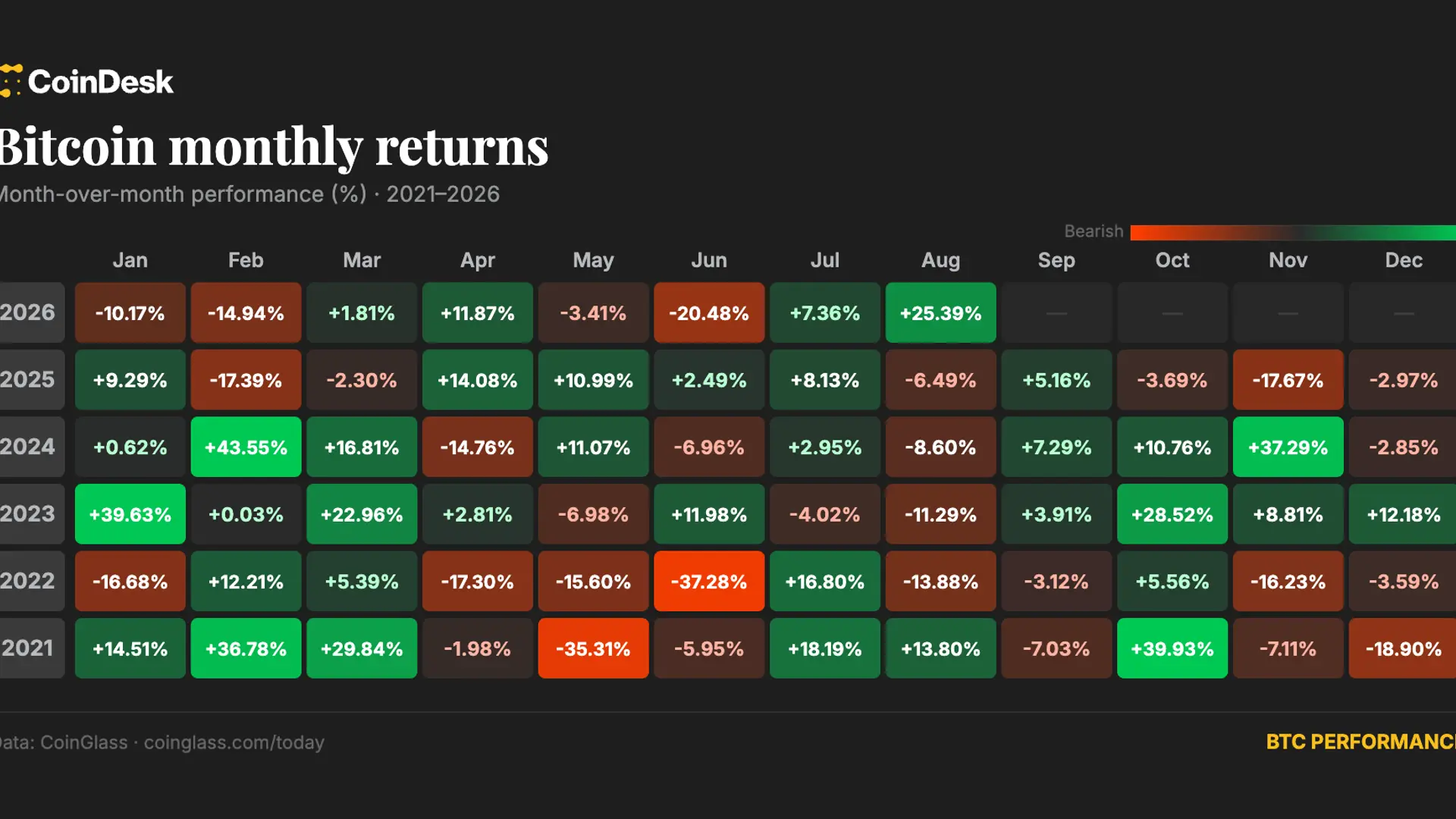
In the final trading session of August, bitcoin is hovering near $79,000, recovering from an overnight tumble that briefly took it to $77,000. The turnaround puts the cryptocurrency on track to close the month with an advance of just over 25% — its best monthly performance since November 2024, when BTC jumped 37% in the aftermath of Donald Trump’s U.S. election victory.
Key facts at a glance
- Bitcoin recovered from a low near $77,000 to trade around $79,000 by Monday afternoon U.S. hours.
- A 25%+ August gain would mark bitcoin’s strongest month since November 2024.
- Crypto-linked equities rallied, with Circle leading a broad advance.
- Strategy resumed buying bitcoin for the first time since late June, adding 4,603 BTC.
- Crude oil jumped after U.S.-Iran fighting escalated, while Fed rate-hike odds rose.
- Ether’s daily chart flashed a golden cross, and BlackRock’s BUIDL regained the top spot among tokenized Treasury funds.
Bitcoin erases overnight decline
Bitcoin fell to $77,000 in the overnight session as crude oil surged after the U.S. launched a fresh round of military strikes against Iran. The geopolitical shock briefly unsettled risk assets, but by Monday morning in Asia, the selling had faded. Prices climbed back through $78,000 and later reached $79,000 — roughly flat over the past 24 hours and nearly 2% above the level where stocks closed on Friday. If bitcoin can hold the $79,000 area through the few remaining hours of trading, August will go into the books with a gain of roughly 25.4%, since the month began near $63,000.
The projected monthly return is significant not just because of its size but because of the timing. November 2024 remains the reference point, when bitcoin soared 37% as Donald Trump’s election win gave traders fresh conviction that the crypto industry would enjoy friendlier tax and regulatory treatment. Since then, monthly gains of this magnitude have been rare. A 25% August would stand out as the most decisive bullish monthly candle in nearly two years and would help repair some of the damage done by the rate-driven drawdowns earlier this year, particularly in May and June when rate expectations pulled institutional money out of U.S. spot bitcoin ETFs.
Crypto stocks follow bitcoin higher
The recovery in digital assets translated into modest gains across the crypto equity complex Monday. Circle, the stablecoin issuer best known for USDC, led the move with a 7.5% advance. No specific catalyst was cited, but a broad rise in U.S. interest rates can be a net positive for Circle’s earnings, since it holds cash-like reserves and earns yield on them. With the entire U.S. Treasury curve pushing higher again, stablecoin margins are getting a tailwind.
Coinbase, the largest U.S. crypto exchange, rose 4.5%. Strategy, the corporate bitcoin holder formerly known as MicroStrategy, was up 2.7%. Galaxy Digital added 2.2%. Among the smaller bitcoin treasury companies, Strive outperformed with a 9.7% jump. Strive last week increased its bitcoin holdings by 1,800 coins, an expansion of more than 8%, bringing its total to 23,156 BTC. The company funded the purchases in part by selling common stock and in part by selling about $80 million of its preferred perpetual stock, SATA, after that instrument returned to the $100 par level. SATA was flat Monday, trading exactly at $100.
The stock moves are a reminder that the public-market bitcoin trade remains sensitive to both spot prices and perceived access to capital. Companies that can issue equity or preferred stock at attractive levels have a structural advantage in adding to their bitcoin reserves. Strive, despite being far smaller than Strategy, has been one of the most aggressive accumulators on a percentage basis.
Fed fears reshape the rate outlook
One of the larger forces behind the market’s tone was a hawkish repricing of Federal Reserve expectations. Treasury Secretary Scott Bessent and Fed Chair Kevin Warsh traveled together to the G20 summit in Asheville, N.C., over the weekend, apparently aiming to project unity. Yet their comments on rates quickly underscored the tension inside the U.S. policy mix.
Bessent said the world is “awash in debt” and that the only way to escape is to “grow our way out of this.” In a separate CNBC interview, he argued that core inflation has remained “very restrained,” a characterization that appears to run counter to Warsh’s warnings last Friday that the Fed still has work to do. Bessent also noted that the central bank has rarely hiked rates into a supply shock, an apparent reference to rising oil prices and their potential effect on inflation.
Warsh’s comments had already sent Treasury yields violently higher. The market did not let up on Monday. The 30-year Treasury yield rose another 5.2 basis points to 5.26%, while the 10-year yield added 4.1 basis points to 4.763% — its highest level in three years. Short-dated yields followed, as traders continued to price in the possibility of imminent tightening.
According to the CME FedWatch tool, there is now a 64% chance that the Fed raises rates at its mid-September meeting, up from 57% on Friday and roughly 40% just before Warsh’s Jackson Hole speech. Looking further out, futures price about a 90% chance of one or more hikes by the December meeting, with nearly a 10% chance that total tightening reaches 75 basis points. The shift in expectations has broad implications for crypto, because higher risk-free yields reduce the appeal of non-yielding assets like bitcoin while also strengthening the dollar.
Oil spikes as Iran conflict intensifies
The geopolitical backdrop added another volatile input. After a night of U.S. attacks against Iran, President Trump wrote on Truth Social that “Iran is officially a failed nation,” citing the absence of a functional navy, air force or currency, inflation running near 300%, and what he described as disarray among the country’s leaders. It was not the first time Trump has declared victory during what has become a nearly seven-month conflict.
Oil responded immediately, with Brent crude up 5.9% to $91.18 a barrel and West Texas Intermediate crude up 3.7% to $86.47. Traders focused on the risk that a continued disruption could threaten oil tanker flows through the Strait of Hormuz, a critical chokepoint for global energy supplies. For bitcoin, an oil spike cuts two ways. It feeds inflation fears, which strengthen the central-bank tightening case. But it also creates exactly the kind of macroeconomic uncertainty that has historically boosted interest in decentralized assets. At least for now, the direct effect appears to have been muted; bitcoin’s overnight dip was bought quickly and the price ended up close to where it started.
Strategy resumes bitcoin buys
In the corporate world, Strategy made its first bitcoin purchases since late June. The company added 4,603 coins for $369.7 million, an average price of $80,318 per bitcoin. Strategy said the acquisition was funded through the sale of $602.8 million of common stock. After accounting for the bitcoin purchase, the company used $151.8 million to buy back its STRC preferred stock and added the remaining proceeds to its cash reserves.
The company, led by Executive Chairman Michael Saylor, now holds 845,050 bitcoin that were acquired for a total of $63.73 billion, or an average price of $75,412 each. In pre-market trading, Strategy shares rose 1.65% as bitcoin hovered around $78,400. The decision to resume buying after a two-month pause may be seen as a signal that Saylor and his team believe the recent pullback in bitcoin, from levels above $80,000, offered a reasonable entry point.
Ether flashes a golden cross
Ether, the second-largest cryptocurrency, produced a technical signal that long-term investors tend to watch. Its daily chart formed a golden cross, meaning the 50-day simple moving average moved above the 200-day moving average. The pattern is often described as a sign that recent price momentum has strengthened relative to the longer-term trend. It does not guarantee gains, but it has historically appeared at the start of sustained bullish phases. Ether’s move came even as its price remained modestly lower on the day, suggesting the technical position was improving before the spot market fully caught up.
Tokenized Treasuries see a leadership change
The tokenized Treasury market also had a notable development. BlackRock’s BUIDL fund retook the position of the largest tokenized U.S. Treasury product, with roughly $2.8 billion under management. That places it in a statistical tie with Circle’s USYC, which sits at a similar $2.8 billion. The two funds now control about 36% of a $15.1 billion market that has gone from curiosity to infrastructure in less than two years.
Tokenized Treasury funds hold short-dated U.S. government debt and issue tokens that represent a share of the underlying portfolio. They allow crypto firms to earn a yield without leaving the blockchain. Securitize handles tokenization and transfer agency services for BUIDL. The fund’s history has been volatile. It topped $3 billion in early 2025, gave back more than a billion, recovered, then fell to near $1.5 billion in the middle of this year before recovering again through August. USYC, by contrast, rose steadily and passed BUIDL earlier in 2026 before the latest rotation.
The broader category has grown more than 15,000% since 2024 and has stayed close to $15 billion through the crypto drawdown. Ondo’s USDY and Franklin Templeton’s iBENJI trail the leaders with roughly $2.1 billion and $1.7 billion, respectively.
Yen volatility: contained but not gone
In currency markets, Bessent described recent moves in the Japanese yen as “pretty well contained” and said they did not require a coordinated U.S.-Japan intervention. That was a meaningful comment because the yen has repeatedly been used to fund carry trades into U.S. stocks and Treasury notes. A disorderly yen could force an unwind of those trades, pushing yields higher and tightening financial conditions more broadly — a dynamic that also affects bitcoin.
The yen briefly broke past 160 per dollar in Tokyo on Monday. Strategists said intervention triggers could start as low as 161, with a deeper reaction likely in the 162 to 163 zone. Still, the currency has already unwound more than half of the gains from a record July operation, when the U.S. joined Japan in coordinated yen buying for the first time since 1998.
Monday’s close matters for another reason: it is the final trading session of August, and the month-end data will show whether the recent streak of inflows into spot bitcoin ETFs survived the sudden repricing in interest-rate expectations. If the inflows held, it would suggest that institutional demand for bitcoin is more resilient than it was during the May and June outflow period. If they broke, it would point to another bout of sensitivity to Fed policy.
Source:Coindesk News