

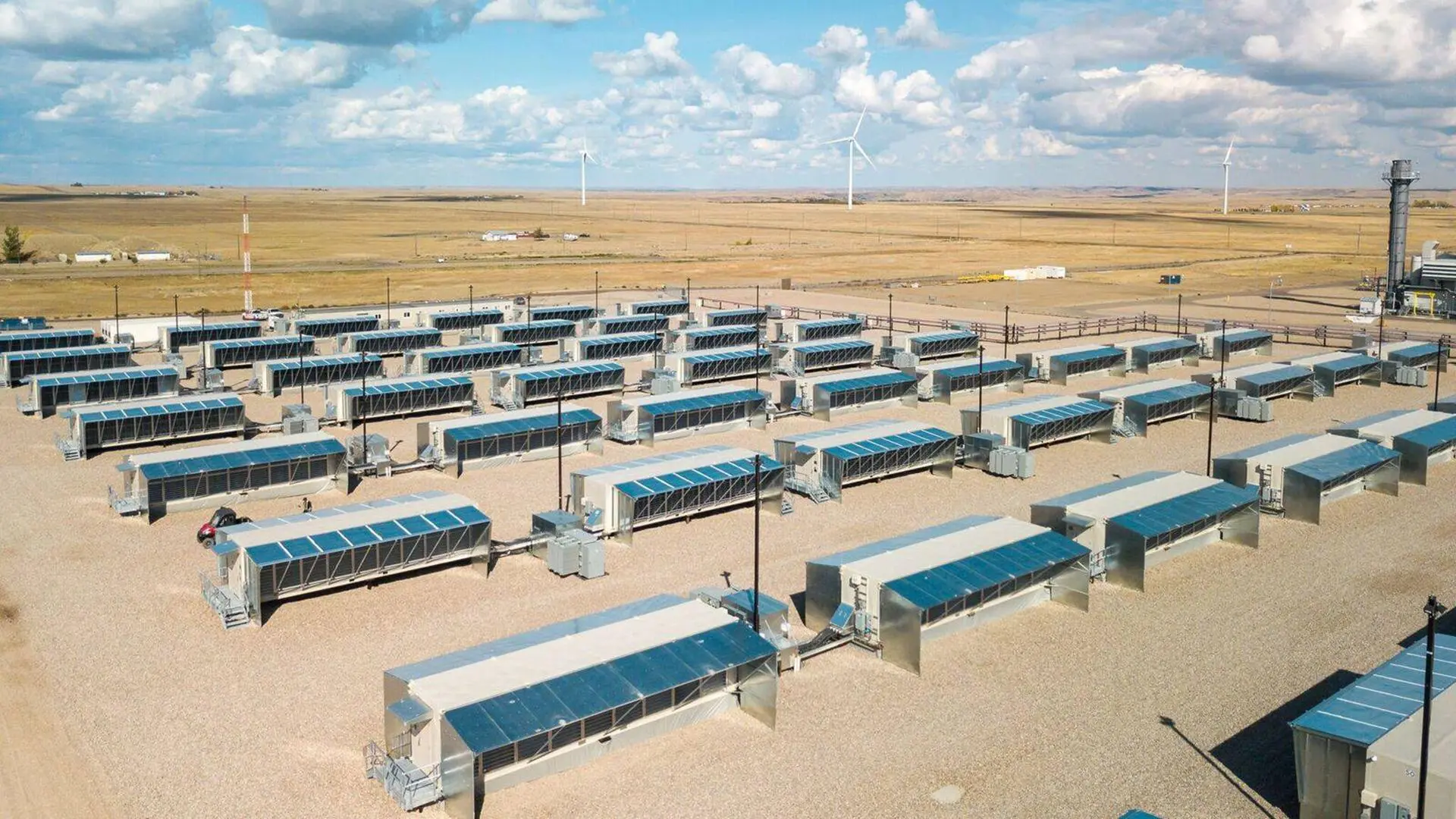
Bitcoin miner Hut 8 has become a key piece of Anthropic's massive $35 billion computing agreement with Lambda, an Nvidia-backed cloud provider. The deal, one of the largest known AI infrastructure commitments to date, includes computing capacity hosted at Hut 8's Beacon Point campus in Texas. The arrangement illustrates how bitcoin miners, once seen as purely crypto-related energy consumers, are being recast as essential suppliers of power and data-center capacity to the artificial intelligence industry. For Hut 8, the contract adds a new strategic layer to a portfolio already built around some of the most scalable power sites in North America.
Hut 8's two long-term leases at Beacon Point are remarkably large. Each lease runs 15 years, and together the contracts cover 704 megawatts. Their combined contracted value is around $19.6 billion, more than 260 times the company's most recent quarterly revenue. That figure alone reveals how much transformation is underway at the firm. A few years ago, a contract of this size would have been difficult to imagine for a bitcoin mining company. But as artificial intelligence developers compete for millions of graphics processing units, they are less concerned with traditional data center real estate and far more focused on finding sites with ample power, land, cooling and grid access. Hut 8 has spent the past several quarters repositioning itself to benefit from exactly that demand.
Anthropic, best known as the developer of the Claude assistant, has been securing data center capacity at a faster pace than many of its rivals. The company's agreement with Lambda calls for it to spend $35 billion on computing services. Hut 8 has not yet publicly confirmed exactly how many megawatts at Beacon Point will be tied to Anthropic's workloads. Still, the scale of Hut 8's leased capacity, combined with Lambda's need for large clusters, suggests Beacon Point could be one of the core sites supporting the deal. The campus is one of Hut 8's flagship facilities and one of the few privately developed AI-ready sites in Texas with access to substantial power capacity.
Historically, Hut 8 was a straightforward bitcoin mining operation. It mined bitcoin at low power prices, used part of its proceeds to pay for electricity and operating costs, and sometimes kept leftover coins on its balance sheet. The company later expanded beyond Canada into several parts of the United States. After the 2024 bitcoin halving reduced mining rewards, the financial pressure on miners increased. Profit margins narrowed, power prices in many energy markets stayed elevated, and investors began asking how mining companies would survive the next price cycle. At the same time, the value of having large amounts of power already interconnected to the grid became more apparent. Data center demand was rising quickly, and AI companies were willing to sign long-term contracts that bitcoin miners had never seen before.
The shift to artificial intelligence infrastructure is not unique to Hut 8. Bitcoin miners across North America are repositioning themselves as data center landlords, offering high-density power and fiber connections to customers that need machine learning compute. The reason is straightforward: AI workloads consume enormous amounts of electricity. A single large training cluster can use more power than a small town. Because hyperscalers and AI labs need guaranteed capacity, they are willing to sign multi-year leases that provide revenue certainty. Miners that already own electrical substations, transformers and high-voltage interconnections have a head start over greenfield developers. For Hut 8, that means the same infrastructure that once powered bitcoin-mining machines can now attract blue-chip AI tenants, often at higher effective rates.
The exact structure of the Beacon Point leases remains a major focus for analysts. The two leases are set to last for 15 years, a duration rarely seen in commercial real estate but increasingly common in data center project financing. The $19.6 billion contracted value assumes a certain level of power becomes available over the life of the contracts. If Hut 8 delivers that power with reliable uptime, the company will generate a revenue stream much larger than what it could produce by running bitcoin miners. The comparison to its current quarterly revenue, where the lease value is more than 260 times larger, helps explain why the market has started treating bitcoin miners differently. Long-duration power agreements turn a volatile business into something closer to a utility.
The investment logic has also changed for the stock. Hut 8 Corp. is no longer solely a play on bitcoin prices. When the company announces infrastructure agreements, investors focus on the contracted cash flows that come from those agreements. The Beacon Point leases, for example, help Hut 8 build a financial profile that includes predictable recurring revenue instead of relying only on the market price of a digital token. That matters because mining revenue is volatile and tied to both coin prices and network difficulty. AI colocation contracts, by contrast, generally include fixed availability payments regardless of whether bitcoin is trading higher or lower. The dual business model gives Hut 8 a way to balance upside participation from mining with downside protection from long-term infrastructure hosting.
The wider data center sector is struggling with one central problem: power is not available fast enough. Utilities in many regions have reported wait times of several years for new large-load connections. Transformer lead times remain high because suppliers cannot keep up with orders from data centers, factories and renewable energy projects. In Texas, the situation is slightly different because wholesale power prices are market-based and some large customers can contract for new transmission service more quickly. Still, bringing entire substations online takes time. Hut 8's existing assets reduce that civil-engineering risk because the site is already designed to handle a heavy electrical load. Converting a portion of a mining site to AI hosting can be simpler than preparing raw land for a new data center campus.
The connection to Texas is particularly important because the state has led the United States in data center growth. Land is relatively available, the business climate is regarded as friendly, and the grid has established a real-time pricing structure that can reward companies that reduce their load during peak events. Hut 8 is familiar with those market signals from years of managing flexible mining loads. By applying the same flexibility to AI data centers, the company can potentially sell demand response or grid services without interrupting critical compute workloads. That may create another revenue stream and improve the efficiency of the entire campus.
Market observers will now watch Hut 8's disclosures for more detail on how much of the 704 megawatts is reserved for the Anthropic-Lambda agreement. The company has not confirmed the exact split, but even a partial commitment would be significant when measured against typical data center lease volumes. In the meantime, Hut 8 continues to operate bitcoin mining at several facilities. Over time, the balance between mining and AI hosting could tilt further toward AI if contracted rates remain above the expected return from miners. The simple fact that a bitcoin mining company's power campus now forms part of a $35 billion AI deal shows how quickly infrastructure narratives have changed.
Source:Coindesk News