

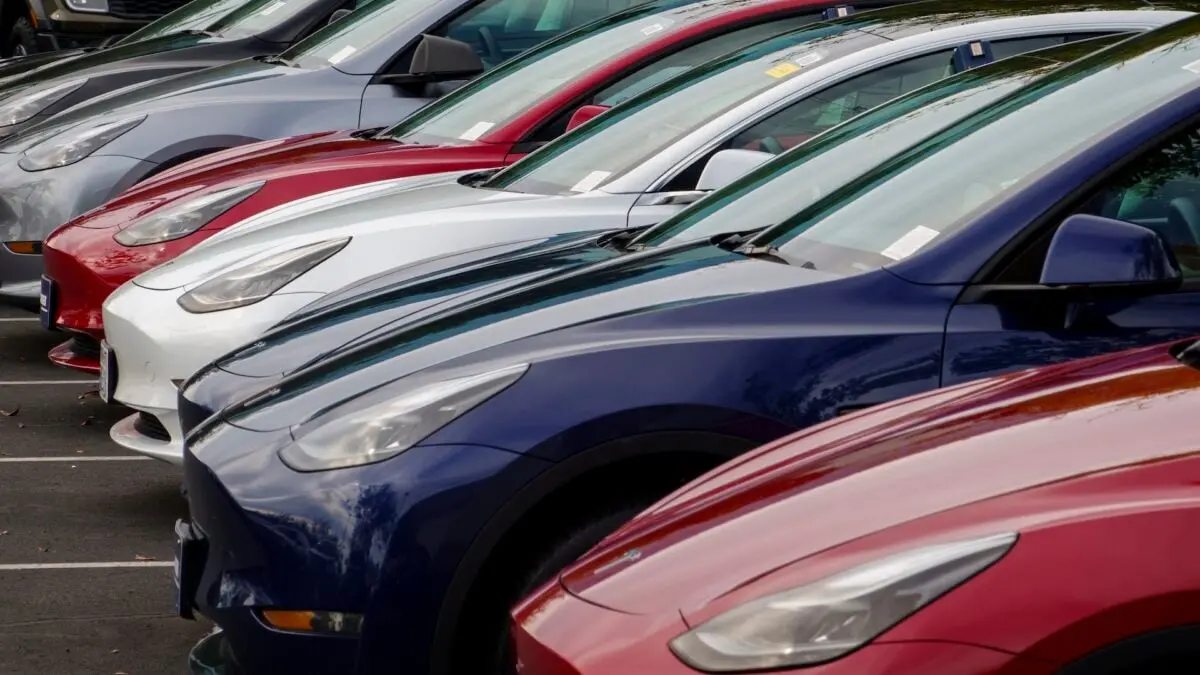
After Tesla’s sales in Europe took a nosedive last year, the company appears to be making a comeback on the continent. While it appeared that Elon Musk’s political maneuvering had soured buyers’ appetites across the pond, time heals all wounds. Tesla said Thursday it plans to hire 1,000 new workers at its Gigafactory near Berlin as part of a push to increase production to 7,500 vehicles per week by October, according to reports. The news arrives just months after Tesla announced a previous round of 1,000 new jobs at the plant and said it planned to increase production to 6,000 vehicles per week by the end of June. This production boost would put Tesla’s German factory on track to produce around 390,000 EVs per year. That is still below the 500,000 cars per year Tesla was targeting when it opened the facility in 2022.
The rebound in European sales is striking. Tesla registrations in Europe rose 57 percent to more than 118,000 vehicles from January through May, compared with the same period last year, according to the European Automobile Manufacturers’ Association. This recovery is driven by rising fuel costs and new government incentives for zero-emission vehicles in Germany. But the timing is ironic. European leaders have spent much of this year talking about the need to reduce dependence on U.S. technology companies. French President Emmanuel Macron stated at the Munich Security Conference in February, “In this new geopolitical environment, Europe has to become a geopolitical power. It’s ongoing, but we have to accelerate and clearly deliver all the components of a geopolitical power, in defence, in technology, and in the derisking vis-à-vis all the big powers in order to be much more independent.”
Earlier this year, the French government announced it would stop using American video conferencing platforms like Microsoft Teams and Zoom, and instead use the French platform Visio. France has also signed a deal for its armed forces to use Mistral’s models and software. Additionally, this month, the European Commission unveiled a “tech sovereignty package” meant to strengthen the bloc’s digital autonomy with a focus on semiconductors, AI, cloud computing, and open-source software. The Commission also announced Thursday that it has reached a preliminary position that Amazon Web Services and Microsoft Azure should be regulated as “gatekeepers” under the Digital Markets Act, the EU’s sweeping antitrust law for large digital platforms.
Yet, electric vehicles should be one of the easiest sectors for Europe to break its dependence on American tech. Unlike cloud computing or social media, Europe already has several homegrown automakers making EVs, including Volkswagen, BMW, and Stellantis. European customers also have more access to options from China, where companies like BYD have been making breakthroughs in driving range and charging speed. But for now, Tesla seems confident European customers will keep making their way back to its showrooms.
The story of Tesla’s European struggles and rebound is deeply tied to Elon Musk’s political activities. Like in the United States, Musk’s hardcore conservative politics, direct involvement in DOGE, and personal ties to President Donald Trump hurt 2025 sales in Europe. At the time, Trump was threatening to take over Greenland and followed through on his promise to impose various tariffs on the continent. Meanwhile, Musk promoted far-right and anti-immigrant movements in Europe, including Germany’s AfD party. More recently, Musk was accused of inciting violence with posts related to violent anti-immigrant demonstrations in Belfast. These actions soured many European consumers on the brand, leading to a sharp decline in Tesla sales across the continent in 2025.
But the tide appears to be turning. Rising fuel costs in Europe have made electric vehicles more attractive, especially as governments offer new incentives. Germany, Europe’s largest auto market, introduced new subsidies for zero-emission vehicles in early 2026, which directly benefited Tesla. The company’s Gigafactory in Berlin, which began operations in 2022, has been ramping up production to meet the renewed demand. The factory now employs thousands of workers and is a key part of Tesla’s strategy to avoid tariffs and cater to local markets. By producing vehicles within the EU, Tesla avoids import duties and can more easily qualify for local incentives.
Despite the political tensions, Tesla’s vehicles remain popular among European buyers. The Model Y was the best-selling car in Europe in 2023 and 2024, and it continues to perform well. The company’s Supercharger network, which is open to other EVs in Europe, also provides an advantage. However, European automakers are fighting back. Volkswagen is investing heavily in its ID series, BMW has the i4 and iX, and Stellantis offers multiple EV models across its brands. Chinese manufacturers like BYD are also expanding aggressively in Europe, offering competitive pricing and advanced battery technology.
The broader question is whether Europe can truly achieve tech sovereignty in the EV sector. While leaders talk about reducing dependence, consumer preferences and market dynamics often override political goals. Tesla’s comeback shows that even when consumers are angry at a CEO’s politics, practical considerations like fuel costs, incentives, and product quality can drive purchases. For European policymakers, this is a sobering lesson. If they want to reduce reliance on American big tech, they need to not only build competitive alternatives but also ensure those alternatives are attractive enough to win over consumers in the marketplace.
The European Commission’s tech sovereignty package includes measures to boost local semiconductor production, support AI startups, and encourage adoption of open-source software. But electric vehicles are a different beast. They require massive capital investments in factories, supply chains, and charging infrastructure. While European automakers are making progress, they still lag behind Tesla in software, battery efficiency, and brand perception. Chinese companies like BYD are also closing the gap rapidly, offering vehicles that sometimes beat Tesla on range and price.
For now, Tesla is hiring and expanding in Germany, signaling its long-term commitment to the European market. The company’s ability to bounce back from a political storm demonstrates its resilience and the strong appeal of its products. But the war on American big tech in Europe is far from over. If Europe wants to win the easiest front—electric vehicles—it will need more than just policy announcements. It will need to produce cars that Europeans actually want to buy, at prices they can afford, with the performance and features they demand. Until then, Tesla and other American tech firms will continue to find a welcoming market in Europe, despite the political rhetoric.
Source:Gizmodo News