

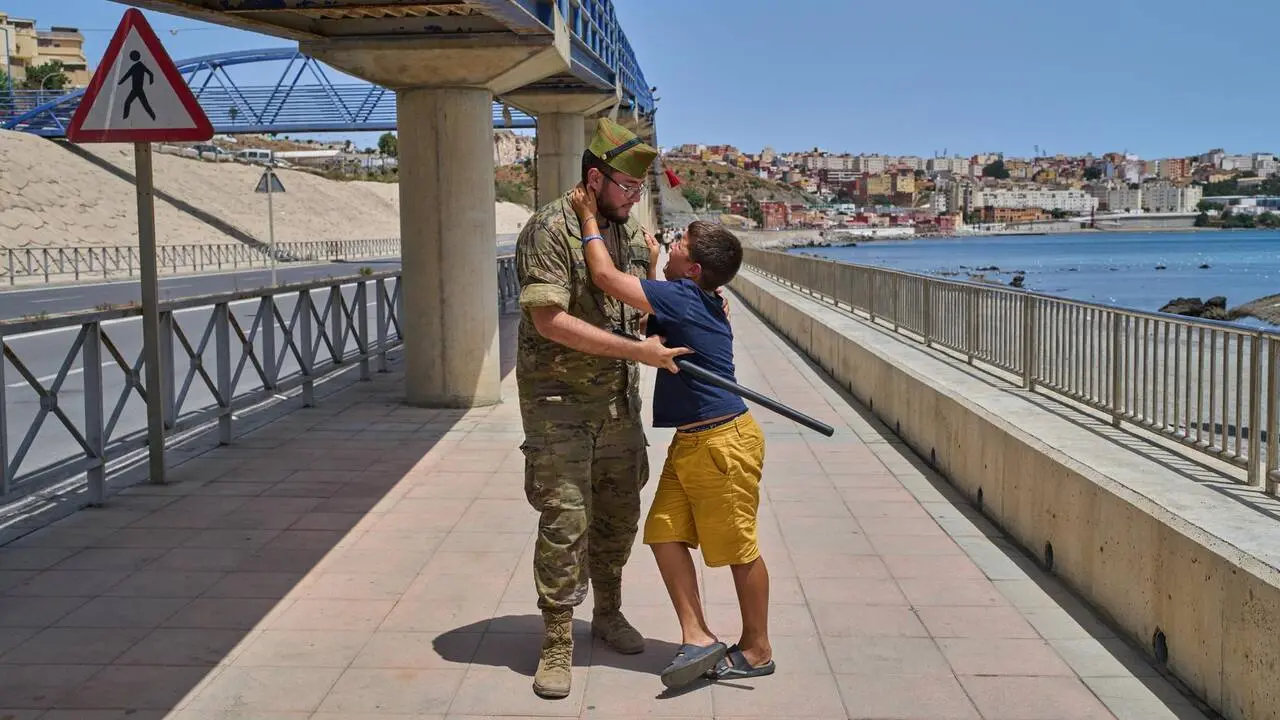
“When Italy and Spain are together, they are stronger.” The words were spoken by Spanish Prime Minister Pedro Sánchez in Rome in 2023, standing beside Italian Prime Minister Giorgia Meloni. They were meant to seal a partnership before Spain took over the rotating presidency of the European Union. Three years later, that partnership is being tested by the recurring Ceuta crisis. The Spanish enclave on the North African coast has become a political stage, and both leaders appear determined to use it for their own electoral benefit.
Ceuta, the open wound on Europe’s southern border
Ceuta is one of Spain’s two autonomous cities in Africa, along with Melilla. It sits on the Strait of Gibraltar, with a land border of barely eight kilometres with Morocco. For decades, it has been a pressure point for migration into Europe. Migrants arrive by sea, by swimming around the breakwaters, or by storming the six-metre fences that mark the frontier. European Union agencies police the area, but local authorities often feel left alone.
In the latest flare-up, hundreds of people attempted to reach Spanish territory in a short period. The Spanish Civil Guard said it had reinforced the border and used non-lethal equipment. Morocco, for its part, delayed its response, leaving the situation in an ambiguous diplomatic space. The scene immediately triggered a political reaction in Madrid and Rome.
Key facts to understand the crisis
- Ceuta is a Spanish city on African land, part of the European Union’s external border.
- The crisis occurs as Spain and Italy face domestic political deadlines.
- Pedro Sánchez and Giorgia Meloni use the border tensions to display firmness before their own electorates.
- The dispute underlines a broader European struggle between migrant protection and securitisation.
An unlikely partnership against a common enemy
Sánchez and Meloni do not come from the same political family. Sánchez leads the Spanish Socialist Workers’ Party, while Meloni heads the post-fascist Fratelli d’Italia, a party with deep roots in the Italian far right. Yet migration has gradually brought them to the same language. During the 2023 meeting in Rome, Sánchez declared: “When Italy and Spain are together, they are stronger.” At that moment, he was preparing for Spain’s presidency of the Council of the EU. Meloni needed allies to soften her image beyond her hard-line base. The meeting produced no formal agreement on migration, but it created an image of southern European unity.
Ceuta changes the meaning of that image. For Meloni, the crisis is proof that the European Union cannot keep its external borders open without paying a price. For Sánchez, the crisis is simultaneously an administrative emergency and an opportunity to reassure moderate voters that his government is not naive.
Sánchez and the electoral calculation in Spain
In Spain, the right-wing opposition, led by the Partido Popular and the radical Vox, constantly attacks the government for being weak on migration. Vox has made the defence of Ceuta and Melilla one of its central issues. It has organised rallies at the border and demanded a permanent military presence. For Sánchez, the Ceuta crisis allows him to respond to that pressure without abandoning his progressive image. His government has sent more police, updated surveillance technology, and announced a diplomatic discussion with Morocco. By doing so, he hopes to take the migration issue away from the hard right before the next electoral cycle.
The timing is delicate. If the border is calm, Sánchez appears in control. If it erupts, he can blame external factors and demand European solidarity. Either way, the crisis keeps his name in the news, which is not always neutral. In Spain, there are regional elections and parliament is fragmented. A sensitive security issue can help a prime minister rebuild authority after failed budget battles.
Meloni’s Italian wager
In Italy, Giorgia Meloni has built her entire premiership around the idea of stopping illegal migration. Her coalition, which includes Matteo Salvini’s Lega, formerly Lega Nord, has restricted the work of humanitarian rescue ships and demanded that Algeria, Tunisia and Morocco block departures. The Ceuta episode gives her a perfect case study: a border, a small city, overwhelmed migrants, and a European partner forced to choose between security and rights.
Meloni does not need to send Italian soldiers to Ceuta to gain from the crisis. She can simply say “we told you so.” Her government has consistently argued that the external dimension of migration is more important than internal quotas. In recent months, she has pushed for EU funding for border barriers and for returns agreements. The Ceuta crisis supports that argument in Brussels.
There is also a domestic aspect. Meloni wants to disprove the idea that her policies are isolated. When a Socialist prime minister adopts the language of border control, she can point to him and say that the whole of Europe is moving toward her position. That is why she has cautiously praised Spain’s response instead of attacking it.
The European dimension and the human rights concern
The European Union has watched the Ceuta crisis with apprehension. Frontex, the border agency, has offered additional support. Some member states argue that Spain should receive more money for fences and surveillance. Others, mostly on the left, say the EU is doing too little to provide legal pathways for migrants and asylum seekers.
The Council of Europe, the Strasbourg-based organisation that promotes human rights and the rule of law, has warned against disproportionate measures. It recalled that the principles of non-refoulement and protection apply, even at an external border. Humanitarian organisations on the ground reported that many migrants were young people from West Africa and the Sahel, fleeing conflict and economic collapse.
That warning does not fit the electoral narratives. Sánchez and Meloni both prefer to speak about order and deterrence. Their mutual recognition in Rome in 2023 was meant to show that two rival governments could defend Europe together. The Ceuta crisis reveals how fragile that convergence is. The border remains open in both directions for political exploitation.
Neither leader wants to resolve the structural causes of migration. Morocco’s role is decisive. Rabat uses migration as a diplomatic instrument. In 2021, thousands of people entered Ceuta without a fight, after Moroccan authorities loosened control in response to a diplomatic dispute with Spain. The same pattern has recurred. Madrid has tended to negotiate with Morocco, offering recognition of its autonomy plan for the Western Sahara in exchange for border cooperation. Rome watches these negotiations closely, because it knows that the same tactics can affect Italian shores.
For now, the Ceuta crisis has not led to an open rupture between Spain and Italy. Rather, it has become a mirror in which each leader sees the reflection he or she needs. Sánchez sees a government that defends the nation while preserving European values. Meloni sees a confirmation that her harsh approach has become the new European consensus. The 2023 slogan about unity has disappeared from official statements. In its place, the more mundane reality of electoral calculation has returned.
Source:Letemps News