

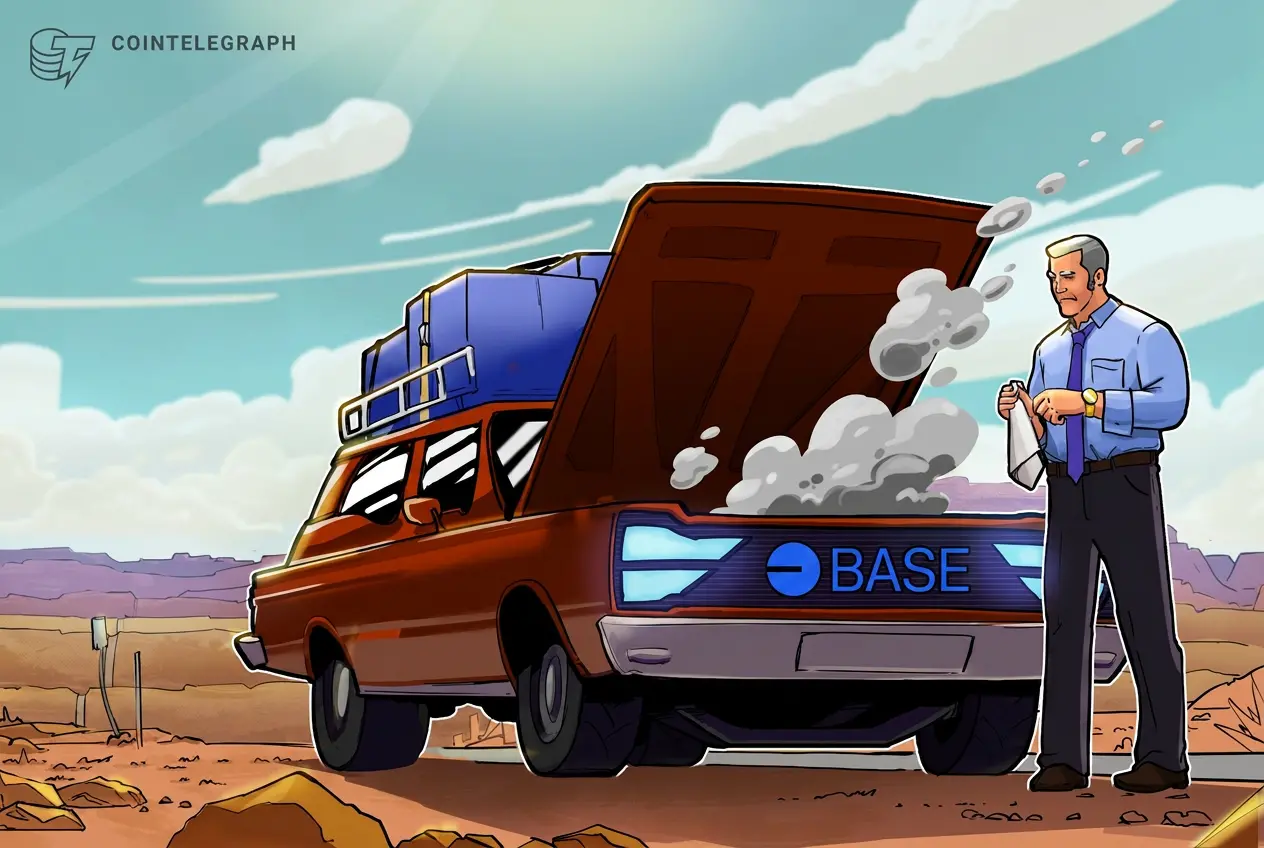
Coinbase's blockchain Base has resumed normal block production after a nearly two-hour outage caused by a consensus issue that temporarily halted the network. The disruption, which occurred on Thursday, June 26, 2026, was a rare instance of downtime for the most used Ethereum layer-2 network.
Base posted on X (formerly Twitter) that blocks were being produced normally again and that widespread ecosystem recovery had been verified. The network's status page first flagged unhealthy block production at 4:03 PM UTC, leading to an investigation. By 5:21 PM UTC, the team confirmed they had isolated a consensus problem: an invalid block had been sequenced, preventing new blocks from being created. Just before 6 PM UTC, Base announced it had recovered healthy block building and that ecosystem-wide infrastructure was syncing. The team stated it would conduct a root cause analysis and share a full post-mortem.
Background and Context
Base is a layer-2 blockchain built on Ethereum, designed to offer faster and cheaper transactions while leveraging Ethereum's security. It was launched in August 2023 by Coinbase, one of the largest cryptocurrency exchanges in the world. The network quickly gained traction, becoming the leading Ethereum layer-2 by total value locked and daily active users. Its previous major outage occurred in August 2025, lasting 33 minutes.
The two-hour downtime on Thursday was significantly longer and raised questions about the robustness of layer-2 infrastructure. While Base creator Jesse Pollack assured users on X that all funds on the network were safe, he acknowledged that a halt is unacceptable for a platform aiming to support global, 24/7 finance. He emphasized that the incident would be used to further strengthen Base's reliability.
The Beryl Upgrade
The outage happened just hours before a scheduled upgrade called Beryl, which was set to go live at 6 PM UTC. The Beryl upgrade was intended to reduce delays on withdrawals and introduce a new token standard for real-world assets and stablecoins. Although the outage was unrelated to the upgrade, the timing added to user concerns. Base proceeded with the upgrade after confirming network stability.
The Beryl upgrade represents a significant step for Base in expanding its functionality beyond simple token transfers. By enabling faster withdrawals, the network aims to improve user experience for decentralized finance applications. The new token standard, optimized for real-world assets and stablecoins, could attract institutional users and traditional finance companies looking to tokenize assets on a compliant and scalable platform.
Comparison to Other Blockchain Outages
Base's outage is not unique in the blockchain industry. Layer-1 blockchain Sui experienced two periods of downtime on consecutive days in May 2026, each causing a temporary halt in block production. Sui attributed the downtime to a network update that had a low probability of causing a halt. Such incidents highlight the delicate balance between rapid innovation and network stability. Even well-funded and heavily tested blockchains can face unexpected issues when deploying critical updates or dealing with consensus mechanisms.
Another notable example is Solana, which suffered multiple outages in its early years due to network congestion and validator coordination issues. Solana's repeated downtimes led to criticism and a concerted effort to improve reliability through protocol upgrades and better error handling. Base's swift response and transparent communication during this outage suggest that Coinbase has learned from these precedents.
Technical Details: Consensus Issues in Layer-2 Networks
Consensus problems arise when validators or sequencers in a blockchain network disagree on the state of the ledger, preventing the creation of new blocks. In the case of Base, an invalid block caused the consensus protocol to stall. This is analogous to a deadlock in distributed systems, where no progress can be made until the conflicting block is identified and removed or reverted.
Base uses a sequencer-based model, where a single entity (Coinbase) initially orders transactions before sending them to Ethereum for final settlement. While this design offers high throughput and low latency, it also introduces a centralization risk. However, Coinbase has committed to decentralizing the sequencer over time. The outage might accelerate those plans, as a single point of failure can disrupt the entire network.
Invalid blocks can occur due to software bugs, incorrect state transitions, or malicious attacks. In this case, Base has not disclosed the exact root cause, but the team's ability to quickly recover suggests that the issue was identified and resolved without data loss. The fact that all funds remained safe indicates that the invariant maintenance provided by Ethereum's base layer worked as intended.
Implications for Coinbase and the Crypto Ecosystem
Coinbase's reputation is closely tied to the reliability of Base. The exchange has invested heavily in promoting Base as a hub for decentralized applications, NFT marketplaces, and DeFi protocols. Any extended downtime could erode trust among developers and users who rely on Base for critical transactions. However, the transparent handling of the incident and the quick recovery may mitigate long-term damage.
The outage also highlights the importance of infrastructure diversity within the Ethereum layer-2 ecosystem. While Base leads in usage, other networks like Arbitrum, Optimism, and zkSync offer alternative platforms. Users and developers may reconsider their dependence on a single layer-2 provider, especially after seeing that even the largest one can experience unexpected halts. This could lead to increased adoption of multi-chain strategies or cross-chain interoperability solutions.
From a broader perspective, the incident serves as a reminder that blockchain technology is still maturing. Outages are inevitable, but how teams respond defines their credibility. Base's commitment to a post-mortem and continuous improvement is a positive sign. The event also underscores the need for robust monitoring, automated failover mechanisms, and redundant consensus protocols to minimize downtime.
In the coming weeks, the crypto community will be watching to see if Base introduces additional safeguards. Proposed solutions might include implementing a fallback consensus algorithm, increasing the number of sequencers, or introducing slashing conditions for misbehavior. Any such changes would need to be balanced with performance and decentralization goals.
Overall, the Base outage, while disruptive, is a learning opportunity for the entire industry. It reinforces the importance of transparency, rapid incident response, and continuous engineering improvements. As blockchains aim to replace traditional financial infrastructure, they must prove they can maintain near-zero downtime. The Base team has taken a step in that direction by quickly restoring service and communicating openly with users.
Source:Cointelegraph News