

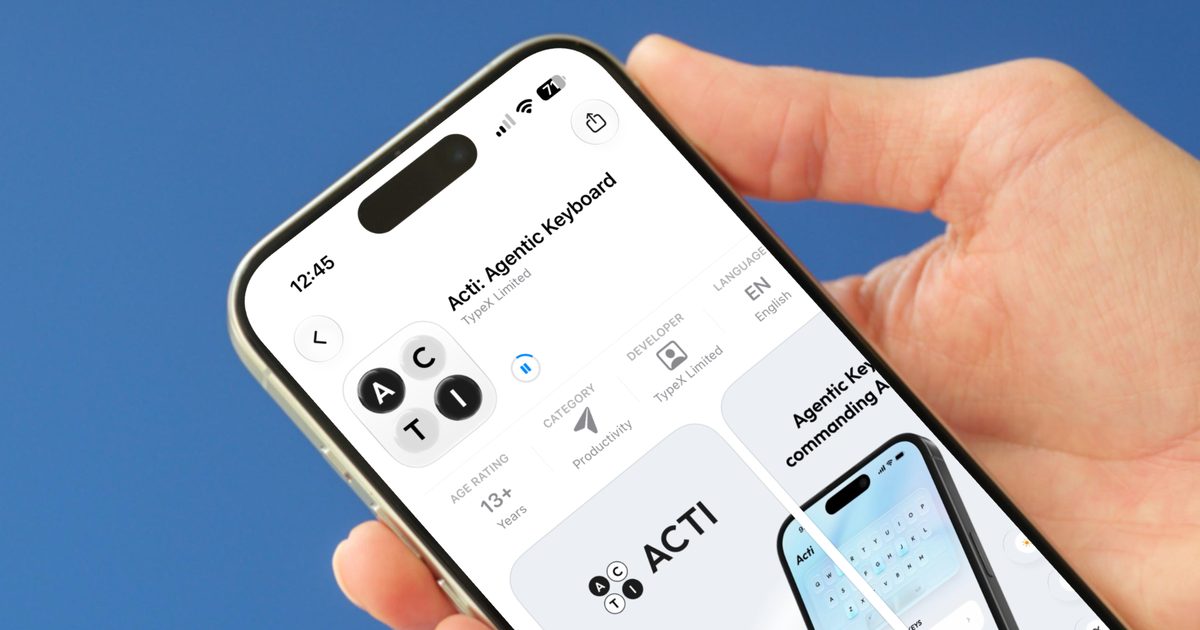
Your smartphone's keyboard is one of the most frequently used interface elements, yet its core functionality has remained largely unchanged for nearly two decades. While predictive text and autocorrect have improved, the keyboard's role is still limited to inputting text. A Singapore startup called Acti is challenging this status quo by transforming the keyboard into an active AI assistant that can perform tasks directly within your apps.
Acti, short for ''action,'' has launched on both iOS and Android. The company describes it as an ''agentic keyboard,'' meaning it doesn't just suggest words but actually executes actions. The key innovation is the ActiBar, which replaces the space bar. Tapping it types a space as usual, but holding it triggers an AI action. For example, if a friend asks for your location in a chat, you can type the address and then hold the ActiBar to automatically find and drop the location into the conversation.
The action system goes beyond simple lookups. Acti can search for nearby restaurants, sports scores, news, and more. When it retrieves information, it can present it as a mini app that the other person can browse interactively. This eliminates the need to switch between apps to find and share data.
Acti also allows users to assign specific actions to any key on the keyboard. By pressing and holding a key, users can trigger integrations with third-party apps. For instance, holding ''N'' could summon a specific Notion document and insert it into your chat, while holding ''L'' might pull up a LinkedIn profile when someone mentions a name. This level of customization makes Acti highly adaptable to individual workflows.
The platform includes a feature called Skills, which lets users create their own shortcuts by describing the desired action in plain language. These Skills can be kept private or shared with the community, fostering a library of user-generated automations. Acti is designed with privacy in mind, processing most data locally on the device. Only actions that require external data (like web searches) trigger cloud connections.
Acti's launch represents a shift in how we think about on-screen keyboards. Rather than being a passive input tool, it becomes an active agent that can save time and reduce app switching. The keyboard's persistent presence on the screen makes it an ideal place for an AI assistant, as it's always accessible without opening a separate app.
Historically, keyboards have evolved from physical layouts to touchscreen interfaces, but their core function remained text input. Predictive text and autocorrect added convenience, but they didn't fundamentally change the keyboard's role. Acti is one of the first commercial attempts to embed full task execution into the keyboard itself. The concept of an ''agentic UI'' has been explored in research, but consumer implementations have been rare.
The AI capabilities behind Acti leverage natural language understanding to interpret user intent. When a user holds the space bar, the keyboard analyzes the current context (like the app and any typed text) and determines the appropriate action. This context awareness is crucial for delivering relevant results without requiring explicit commands.
Acti is free to start, with plans to introduce subscriptions for premium features. The company is targeting a broad audience, from casual users who want quicker access to information, to power users who want to automate repetitive tasks. The community Skills hub could become a valuable resource for sharing workflows.
Competitors in the AI keyboard space include Microsoft's SwiftKey, which has integrated Bing search and text generation, and various standalone AI writing assistants. However, Acti differentiates itself by focusing on task execution rather than text generation or prediction. Its key customization and mini app sharing are unique features not found in other keyboards.
The broader trend of AI integration into everyday tools is accelerating. Smartphone keyboards are a natural battleground because they are used billions of times daily. Acti's approach suggests that future keyboards will not only type for us but also act for us. The success of Acti will depend on how well it handles complex tasks across different apps and how intuitive its gesture-based controls become.
Early impressions of Acti show promise. The space bar hold is a familiar gesture that doesn't disrupt typing flow. The ability to fetch and share data in real time feels like a superpower compared to manual copy-pasting. The mini app sharing feature is particularly clever, as it enriches the recipient's experience without requiring them to have Acti installed.
However, challenges remain. The keyboard must work consistently across thousands of app variations, and privacy concerns about what the AI ''sees'' will need ongoing transparency. Acti's local-first architecture addresses some of these concerns, but users may still be wary of giving a keyboard so much access.
Acti also faces the hurdle of user adoption. Changing keyboard habits is difficult; many people stick with default keyboards for years. Acti hopes its viral potential—where one user sends a mini app to another, sparking curiosity—will drive downloads. The company is also investing in tutorials and a Skills marketplace to lower the learning curve.
Looking ahead, Acti could expand its AI capabilities to include voice commands, translation, and even visual recognition (e.g., pulling data from images). The keyboard form factor could also evolve to support multimodal inputs. For now, Acti is a bold reimagining of the smartphone keyboard that truly does more than just type.
Source:Digital Trends News